T Techclick All lessons
Zscaler ยท Batch 11 ยท Lesson 14EXAM PREP / L2-L3

ZDTA Certification & Interview Prep โ€” Blueprint, 4-Week Plan, 25 Scenario Questions

Your finisher โ€” ZDTA blueprint by domain weight, a 4-week study plan, exam-day tactics, and the 25 real scenario interview questions your trainer has been asked and asks. Make the cert pay back.

๐Ÿ“… 23 May 2026 ยท โฑ 16 min read ยท ๐Ÿท 10-question assessment included
๐ŸŽฏ By the end of this lesson, you'll be able to

1. Why this lesson matters

You have sat through thirteen lessons. You know the ZIA cloud architecture, the five forwarding methods, SAML mechanics, URL Filtering, SSL Inspection, ATP, DLP/CASB, ZPA from connector to policy, CBI, ZDX, and the troubleshooting playbook. That is real knowledge. But on a resume it is invisible. A recruiter scrolling 200 CVs in twenty minutes is not reading your bullet points. They are searching for one string: ZDTA.

The certification is what makes a hiring manager actually open your resume. The 25 scenario interview questions in this blog are what makes them shortlist you over the other ten ZDTA holders. And the specialization track โ€” EDP for ZIA, ZPA, or ZDX โ€” is what gets you the L3 SASE roles where the comp jump actually shows up. This blog is the playbook for all three.

Post-2024 Zscaler cert ladder: ZDTA โ†’ EDP (Engineering Deployment Practitioner) tracks for ZIA / ZPA / ZDX โ†’ ZCCP (Certified Cybersecurity Professional) capstones. The old 'ZIA Admin' / 'ZPA Admin' names retired with the 2023 program refresh.

One blunt note before we start: certifications without lab time get caught in interview rounds. A hiring manager who has run a real ZIA rollout can detect "paper certification" inside three follow-up questions. So treat the cert as a forcing function โ€” it makes you study โ€” and treat this course's simulators as the lab where the answers stick.

2. The three Zscaler certifications worth your time

Zscaler publishes a long catalog of trainings and badges. Most of them are marketing assets โ€” sales-enablement style courses that look good on LinkedIn for a week. Skip those. For an engineer trying to get hired into an L3 SASE role, exactly three certifications matter:

The exact sequence to follow: ZDTA first โ†’ then one specialization based on your role โ†’ then the second specialization six months later. Going for a specialization before clearing ZDTA is a common mistake โ€” it skips the cross-platform fundamentals that the specialization exams assume you already know.

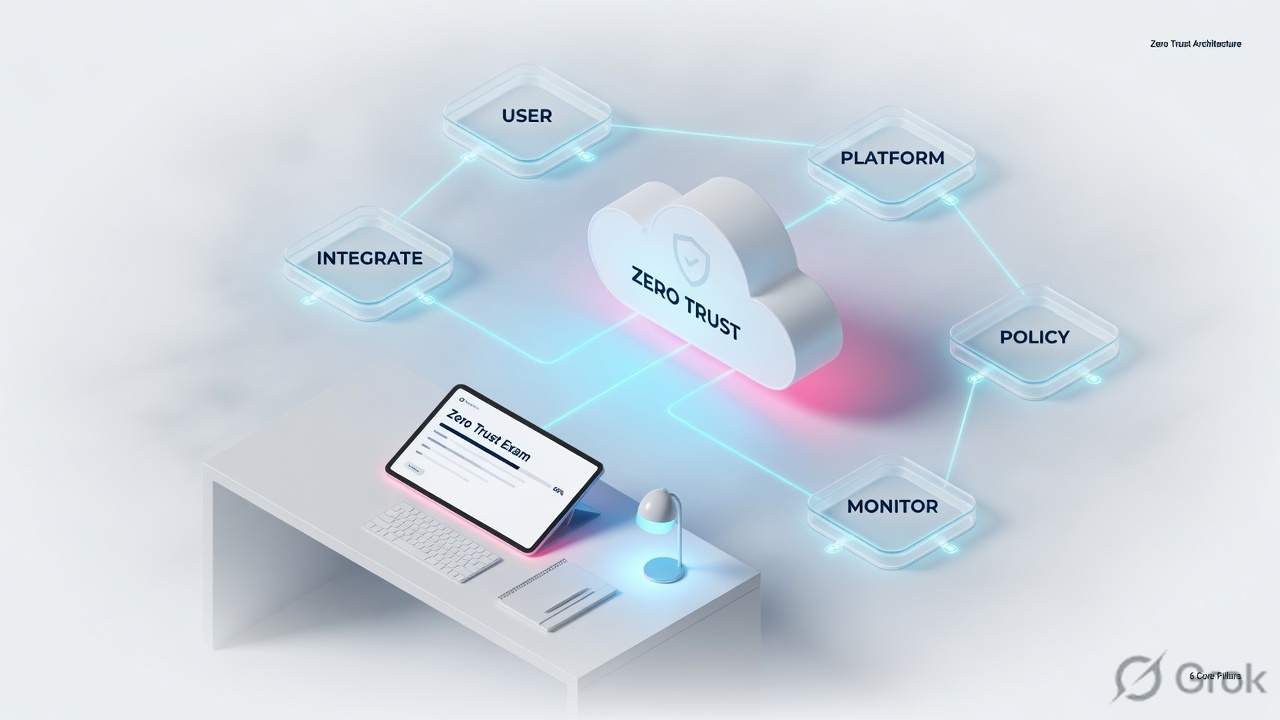
3. ZDTA blueprint โ€” the six exam domains

The ZDTA exam runs 75 questions in 90 minutes (post-2024 refresh; some legacy cohorts saw 60). Passing: 70%. The exam blueprint covers broad domains. Weights below are practitioner estimates based on the official outline โ€” they shift slightly per exam version, but the relative proportions hold. Use this table to plan your hours.

Note: Zscaler's published ZDTA blueprint uses these official domain names: Zero Trust Architecture, Internet & SaaS Access, Private Access, Digital Experience, Implementation. Weights below are Techclick's estimate from cohort feedback โ€” verify against the current official blueprint at zscaler.com/training.

DomainWeightMaps to lessonsCheap-points to grab
Zero Trust foundations โ€” SASE vs SSE, the Zero Trust Exchange, ZIA/ZPA/ZDX pillars, BeyondCorp lineage~15%L1, L2Definitions are pure recall โ€” easy marks if you can name the three pillars and explain why SSE is a subset of SASE
ZIA core โ€” Service Edges, Sub-Clouds, forwarding methods, ZIA policies, URL/Cloud App, SSL Inspection, File Type~25%L2, L3, L5, L6Forwarding method trade-offs and policy evaluation order are bread-and-butter โ€” drill them
ZIA security stack โ€” ATP, Sandbox, IPS, DLP, CASB, Browser Isolation triggers~15%L7, L8, L12Knowing which engine fires first (URL โ†’ SSL โ†’ ATP โ†’ DLP) wins multi-engine scenario questions
ZPA core โ€” App Connectors, Application Segments, Server Groups, Access Policy, Posture, Browser Access~20%L9, L10, L11App Segment vs Server Group vs Segment Group naming is a classic confusion trap โ€” clear it once and you bank ~3 questions
Identity, ZCC & Deployment โ€” IdP integration (SAML, SCIM, JIT), ZCC profiles, Trusted Network, mass-deployment~15%L4SAML assertion flow is testable and re-usable across many questions โ€” memorize the seven steps
Troubleshooting & Operations โ€” Insights/Logs, ZDX scores, NSS, common failure modes~10%L13Most candidates under-study this domain โ€” the marks here are easy if you simply did the work

Total weights add to roughly 100%. The lesson here: ZIA core + ZPA core together are ~45% of the exam. If you are weak on those two, no amount of Zero-Trust definitions will save you. Conversely, the troubleshooting domain is only ~10% โ€” but it is also where most candidates leave easy marks on the table because they "didn't have time to revise it".

4. The 4-week study plan

Four weeks is the sweet spot for ZDTA if you are already working through this course. Less than three weeks and you will pass only on memorization (and likely fail the next month when an interviewer probes). More than six weeks and motivation decays. Here is the plan that has worked for the students who cleared in the last two batches:

WeekFocusDaily commitmentRe-read targetsLab tasksMock-exam goal
Week 1 โ€” ZIA coreZero Trust foundations, ZIA architecture, forwarding, identity1.5โ€“2 hrs/dayLessons 1, 2, 3, 4, 5, 6Walk the ZIA Admin Portal โ€” Locations, Sub-Locations, Service Edges, Forwarding profiles. Build one URL Filtering rule.End of week: ZIA-only quiz from mock pool โ‰ฅ 60%
Week 2 โ€” ZIA security stackSSL Inspection, ATP, DLP, CASB, Sandbox1.5โ€“2 hrs/dayLessons 6, 7, 8Trigger a Sandbox detonation with an EICAR sample. Build one DLP rule. Distribute Zscaler Root CA to a test laptop.End of week: full ZIA section โ‰ฅ 70%
Week 3 โ€” ZPAZPA architecture, Connectors, Application Segments, Access Policy, Posture2 hrs/dayLessons 9, 10, 11Stand up two App Connectors. Define one Application Segment for an internal web app. Order three Access Policies and check evaluation.End of week: full ZPA section โ‰ฅ 65%
Week 4 โ€” Polish + mocksCBI/SIPA, Logs/ZDX, Troubleshooting + 2 full mock exams2.5 hrs/dayLessons 12, 13 + light re-read of weak chaptersRun zscaler-troubleshooting simulator end-to-end. Open Insights Web logs and reproduce a "rule not matching" investigation.Two full 60-question mocks, both โ‰ฅ 75%. If either < 70%, push exam by one week.

One rule that sounds obvious but breaks most plans: do not skip lab tasks because they "feel slow". Reading about a Sub-Location and clicking through one in the GUI are two different memories. Interview questions reward the second.

Troubleshooting Drill App Connector Lab Cloud Connector Lab

5. Exam-day tactics

By the morning of the exam you cannot learn more material โ€” but you can absolutely lose 10โ€“15 marks to bad pacing and trap patterns. Treat exam day as its own skill.

๐Ÿ’กPro tip โ€” last 20 minutes

Reserve the last 20 minutes for two passes over flagged questions: pass 1 for any question you flagged on first read, pass 2 for any with an answer you still feel unsure about. Most candidates flip 2โ€“4 answers on a second pass โ€” that is often the difference between 68% and 72%.

6. ZIA Admin specialization โ€” when to pick it

The ZIA Admin certification goes deep on the parts of ZIA that the ZDTA only touches lightly. If you spend most of your week inside the ZIA Admin Portal โ€” writing URL Filtering rules, troubleshooting SSL Inspection on a pinned banking app, tuning a DLP dictionary that is generating false positives, defining NSS feeds to your SIEM, configuring CASB tenant restrictions for Office 365 โ€” then this is your specialization. It also makes sense if you are interviewing for an L3 SSE role at a customer where ZPA is not yet rolled out.

What you will be tested on beyond the ZDTA: advanced URL Filtering with custom categories and time quotas, SSL Inspection exception design (the "pinned app problem" at scale), the full DLP engine (dictionary tuning, ICAP, exact-data match), CASB policy beyond the basics, and NSS-to-SIEM data engineering (categorization, field mapping, JSON vs LEEF). The exam expects you to know the GUI cold โ€” not just the concepts.

7. ZPA Admin specialization โ€” when to pick it

The ZPA Admin certification is the right specialization when your day-job is Zero Trust Network Access first โ€” VPN replacement projects, ZTNA rollouts for contractors, application onboarding at scale, troubleshooting Z-App for a user who "can't reach the app". The differentiator is depth on the App Connector itself: HA design, sizing, OS patching, the connector boot sequence and its TLS tunnel to the broker.

Topics that go deeper than ZDTA: Application Segment design at scale (wildcards, port ranges, multi-segment apps), Server Group vs Segment Group decision logic, Access Policy ordering with multiple posture profiles, Browser Access for clientless use cases, Privileged Remote Access for third-party admins, and the Source IP Anchoring feature for legacy apps that filter by IP. Expect questions where the wrong answer is "open a wider App Segment" and the right answer is "split into two narrower Segments with different posture profiles".

8. The 25 scenario interview questions

These are the questions that come up in real interview loops โ€” drawn from interviews this trainer has sat through, and from candidate debriefs after Indian MNC, GCC, and Singapore-based SaaS rounds. Model answers are written the way a working L3 engineer would speak โ€” direct, scoped, decision-led. Memorize the shape of the answer, then make it your own with your own production stories.

Block A โ€” ZIA (5 questions)

ZIA ยท Q1

Q: Walk me through how you'd pick between GRE, IPSec, PAC, and ZCC for forwarding traffic to ZIA at a 50-branch organization.

Model answer: Default branch transport is IPSec IKEv2 โ€” modern router support, NAT-friendly, less MTU pain than GRE. GRE only if the branch sits behind a Cisco ISR class device with mature GRE-keepalive support and clean MTU. PAC files cover lab subnets and BYOD where I can't run an agent. ZCC is mandatory for laptops and roaming users โ€” branch tunnels stop helping the moment the user is on hotel Wi-Fi. So for 50 branches I'd run IPSec primary, PAC as the local override, and ZCC fleet-wide for everything that moves.

ZIA ยท Q2

Q: SSL Inspection is breaking a partner banking application. How do you triage?

Model answer: First confirm the app uses certificate pinning โ€” most banking and payments apps do. I check Insights Web logs filtered on the user and URL to see whether the failure is a TLS error before the request was decrypted or a 403 after. If it's pinning, the fix is an SSL Inspection exemption โ€” bypass the host (not disable the engine globally), and document it. If it's not pinning, I check whether the Zscaler Root CA is trusted on that device. The wrong move is to disable SSL Inspection for that user's whole policy โ€” that opens everything else they touch.

ZIA ยท Q3

Q: Your DLP engine is generating a flood of false positives after a dictionary update. How do you stop the noise without disabling DLP?

Model answer: I pull the last 24 hours of DLP incidents grouped by rule and dictionary, find the offending dictionary, and look at the actual matched substrings. Usually it's a pattern that's too loose โ€” a 9-digit number masquerading as a PAN. The fix is to tighten the regex, add a proximity keyword, or move the rule to "alert" instead of "block" while I tune. I keep the rest of the DLP policy active. The wrong move under pressure is to disable the entire engine โ€” that's a 24-hour data-exfil window that auditors will catch.

ZIA ยท Q4

Q: RTT to your ZIA POP just jumped 80ms for ONE user, others fine. Walk the diagnostic.

Model answer: Single-user latency spike with peers healthy points away from Zscaler edge and toward the user's last-mile. Open ZDX โ†’ Device + Network probes for that user โ€” Wi-Fi signal, ISP info, gateway latency. Run a traceroute from Z-App (built into the diagnostic) to the assigned POP โ€” the spike usually shows on the first 2โ€“3 hops (home router or ISP). Also check ZDX CloudPath to confirm POP assignment hasn't flipped to a farther region (Trusted-Network detection or a sub-cloud failover can re-pin the user). Conclude with a peer comparison โ€” if ZDX scores for users on the same POP are normal, you have evidence to push the ticket back to the user's ISP, not own it inside the Zscaler stack.

ZIA ยท Q5

Q: User says "Zscaler is slow" but ZDX shows score 92. Where is your bias and how do you confirm?

Model answer: The ZDX score is dominated by synthetic probes โ€” it tells me the path is healthy from the agent at the moment it probed, not that the user's actual transactions feel fast. The bias is trusting a green dashboard over a human signal. Confirmation path: switch from synthetic to RUM / Web probes for that user; pull Web Insights for the last hour, filter by user, look at actual transaction times and any TLS-Fail / Cloud App Control rule hits; check if the user is on a heavy DLP rule. If RUM and Insights both look clean while the user still reports slowness, pivot to the endpoint โ€” CPU, AV scan, browser extensions. The L3 move is never "the dashboard says 92, you're wrong" โ€” it's "let me look at YOUR actual transactions".

Block B โ€” ZPA (5 questions)

ZPA ยท Q6

Q: How would you design App Connector HA for a data center that hosts 40 internal applications?

Model answer: Minimum two connectors per data center, on different ESXi hosts and ideally different network paths, joined to a single Connector Group. ZPA load-balances and fails over within the group, so I don't manually pin apps to connectors. Each App Connector sizes to ~2,000 concurrent sessions at minimum spec (2vCPU/4GB) with bursty headroom. Plan: peak concurrent sessions ร— 1.5 for HA + maintenance burst. Two connectors handle a few thousand users; four is appropriate for 4-figure user bases with maintenance windows. I also separate Connector Groups by data-center geography so a Mumbai user doesn't get routed to a Singapore connector by accident; that's done via the Server Group โ†’ Connector Group mapping on each App Segment.

ZPA ยท Q7

Q: A developer asks for a wildcard Application Segment covering `*.internal.corp` on all ports. What do you do?

Model answer: Push back. Wildcards on all ports defeat Zero Trust โ€” every internal app becomes reachable by anyone whose Access Policy hits that segment. I ask which specific FQDNs and which specific ports, and split into per-app or per-app-family segments. If the developer truly can't enumerate, I create a narrower wildcard (specific subdomain + specific port range) with a stricter Access Policy โ€” group-scoped, posture-required โ€” and put a 30-day review on it. The wildcard "convenience" today is a breach blast radius later.

ZPA ยท Q8

Q: Your posture profile checks for "AV running and disk encryption ON". After a fleet OS upgrade, half your users fail posture. How do you respond?

Model answer: Don't loosen the posture โ€” that's the easy wrong answer. First confirm scope: same OS version? Same AV product? Almost always it's a Windows update that renamed a service or moved a registry key the posture check is reading. I open the Z-App diagnostic, grab the posture evaluation log, and identify the failing check. Then I update the posture profile to detect the new signal โ€” or, if it's a brief transient, mark posture as "warn" instead of "deny" for 48 hours with an explicit IT comms. Logging and visibility never lower.

ZPA ยท Q9

Q: Explain the order in which ZPA evaluates Access Policies, and what happens when nothing matches.

Model answer: ZPA Access Policies are evaluated top-down, first-match-wins, per Application Segment. Once a policy hits "allow" or "deny", evaluation stops for that user/app pair. If nothing matches, the default is implicit deny โ€” there is no implicit allow in ZPA, which is one of the things that makes it different from a firewall rulebase. So the operational practice is: keep specific allows at the top, broader allows below, and an explicit deny-all log rule at the bottom so you can see what's being denied by default.

Caveat: ZPA reorders client-type policy and timeout policy independently of access policy. Don't assume rule order is sequential across all policy families โ€” check each family separately. Standard interview trip-up.

ZPA ยท Q10

Q: What's the difference between a Server Group, a Segment Group, and an Application Segment? When do you use each?

Model answer: Application Segment is the "what" โ€” the FQDN(s) and port(s) of the actual application. Server Group is the "where" โ€” the Connector Group(s) that can reach those servers; you attach a Server Group to a Segment to tell ZPA which connectors to use. Segment Group is the organizing layer โ€” you group related App Segments together so you can write one Access Policy against the whole group instead of N policies. Mixing them up is a classic interview trap; the easy way to remember it is App = what, Server = where, Segment Group = how to manage at scale.

Block C โ€” Cross-cutting / SASE design (5 questions)

DESIGN ยท Q11

Q: Correlate a ZIA Web log with an EDR detection without joining on username (identity attribution lag).

Model answer: The classic SIEM trap โ€” username from ZIA may lag the EDR detection by minutes (SCIM sync, session age, agent retry). Join on three keys instead of one: (1) destination IP/FQDN, (2) timestamp ยฑ 60 seconds, (3) user-agent string or source IP if the endpoint is on a static internal subnet. Splunk: | join type=inner dest_ip [search index=edr | bin _time span=60s] | where abs(zia_time - edr_time) < 60. Result: high-confidence correlation even when usernames don't line up. If you also have ZIA Web's tenant-assigned session ID and EDR's process ID landing in the same time window, you've got the full attribution chain without needing identity to match.

DESIGN ยท Q12

Q: Design a hybrid where ZIA, ZPA, and an existing on-prem proxy must co-exist for 12 months during a migration.

Model answer: Phase the cutover by traffic class. Outbound web on managed laptops goes through ZCC โ†’ ZIA from day one โ€” that's the easy win. Branch traffic stays on the on-prem proxy via PAC, with ZIA as the upstream forward proxy so we still get cloud inspection. Internal app access starts with VPN for everyone, then I onboard apps to ZPA in waves โ€” pilot group, IT, then the rest โ€” keeping VPN as fallback. The on-prem proxy gets decommissioned only after both ZIA bypass-list parity and ZPA app coverage are validated for 90 days. The risk to flag: don't run ZIA and the on-prem proxy in chained forward-proxy mode forever โ€” debugging chained proxies is a nightmare.

DESIGN ยท Q13

Q: App Connector tunnel down but broker UP โ€” what's the failure mode and where do you look?

Model answer: Broker (ZPA Service Edge) UP + Connector tunnel DOWN means the connector can't establish or maintain its outbound 443 mTLS tunnel to the cloud, even though the cloud itself is reachable. Almost always one of three things: (1) egress firewall blocking the connector's outbound 443 to Zscaler IPs (a recent firewall change is the usual cause); (2) outbound SSL/TLS middlebox (proxy, NGFW with TLS inspection) breaking the mTLS handshake โ€” connectors don't accept MITM, you must add a bypass; (3) certificate expiry or NTP drift on the connector VM. Diagnostic path: SSH the connector โ†’ journalctl -u zpa-connector -n 200 โ†’ look for TLS handshake errors and the destination cloud FQDN it's trying to reach. curl -v https://<broker-fqdn>:443 from the connector to test outbound. If curl works but the connector service can't establish mTLS, you're in case (2) or (3).

DESIGN ยท Q14

Q: Sub-Cloud failover triggered Saturday night. What's the blast radius and what's already in your runbook?

Model answer: Sub-cloud failover means user traffic now egresses from a different PSE (Public Service Edge) IP pool. Blast radius: (1) any third-party SaaS or partner API that allow-lists Zscaler egress IPs by region will reject the new IPs until the allow-list updates; (2) GRE/IPSec tunnels keyed to the original PSE may need to re-establish to the failover pool; (3) ZDX scores can dip for 5โ€“15 min as probes redistribute. Runbook items: pull the current PSE IP list from the Zscaler config feed (cenr.json), diff against the firewall/SaaS allow-list, notify the partner ops queue with the new IPs, validate one test flow per critical SaaS, monitor ZDX score recovery. Don't change anything Zscaler-side โ€” failover is the intended behavior. The communication out is what makes the difference between a 20-minute footnote and a 4-hour partner escalation.

DESIGN ยท Q15

Q: NSS feed has stopped sending events to Splunk for 20 min โ€” buffer is full. Triage.

Model answer: NSS buffers ~10 min of logs in memory before it starts dropping; full buffer for 20 min means either the SIEM side stopped ack'ing or NSS lost outbound to the SIEM. Order of checks: (1) Splunk indexer ack lag โ€” show kvstore-status / queue depth on the indexer; if indexer is the bottleneck, restart there. (2) Network path โ€” telnet/nc from NSS VM to the Splunk receiver port; firewall change or TLS cert rotation is a frequent cause. (3) NSS VM health โ€” nss-stats CLI for buffer depth, EPS in/out, disk; journalctl -u nss for parser errors after a recent feed config change. If buffer is drainable, restart the NSS service to flush; if buffer is wedged, the in-memory buffer is lost (that's the data-loss window the auditor will ask about). Document the gap, file the data-loss incident, and consider switching to NSS-for-SIEM (cloud-to-cloud) for the affected feed if the on-prem path keeps breaking.

Block D โ€” Troubleshooting (5 questions)

TROUBLE ยท Q16

Q: A PAC file is deployed but users still go direct to the internet. How do you troubleshoot?

Model answer: Start at the browser. Inspect the browser's proxy settings โ€” confirm the PAC URL is set and reachable. Then `curl` the PAC URL from the user's machine to make sure the file is actually served (no DNS or firewall blocking). Open the PAC in a text editor and trace the `FindProxyForURL` logic against the URL the user is hitting โ€” most "PAC not working" turns out to be a malformed condition that returns DIRECT for the test URL. Lastly check whether Trusted Network Detection is flipping the user to a different forwarding profile that bypasses the PAC entirely.

TROUBLE ยท Q17

Q: SSL Inspection breaks one specific app โ€” only that app, only for some users. Where do you start?

Model answer: Reproduce on one affected user, capture the Z-App diagnostic, and pull the matching Insights Web entries. The pattern usually points to one of three causes: cert pinning on the app (fix: SSL exemption for that host), a missing Zscaler Root CA on only the affected users' devices (fix: distribute via MDM), or the user being on a Sub-Location whose policy chains a different SSL Inspection profile. Don't broaden the SSL exemption beyond the specific host โ€” and document the bypass with an expiry review.

TROUBLE ยท Q18

Q: "This ZPA app is unreachable" โ€” what's your check sequence?

Model answer: Layer by layer. (1) User authenticated to ZPA? Check Z-App status. (2) App Segment defined and includes the right FQDN/port? Check ZPA Admin Portal โ†’ App Segments. (3) Access Policy allows this user/group at this posture? Check Policy โ†’ Access. (4) Server Group attached to the Segment maps to a healthy Connector Group? Check Connector status. (5) Connector can actually reach the back-end IP on the back-end port? SSH the connector, `nc -zv` the target. Most "unreachable" calls die at step 2 (typo in FQDN), 3 (group not in the policy), or 5 (back-end firewall blocking the connector's source IP).

TROUBLE ยท Q19

Q: Sudden flood of DLP false positives starting Monday morning โ€” what's your first move?

Model answer: Don't change DLP yet. First, correlate โ€” Insights DLP by rule and by user โ€” to see whether it's one rule, one user group, or one app. Then check the change log: was a dictionary updated, a new rule pushed, or a policy reordered over the weekend? Usually a Monday flood is a Friday change. If the root cause is a new rule or dictionary, roll back or scope it tighter and re-enable; if it's a new app suddenly in scope, add the app's known-safe upload pattern to an allowlist. Communicate with the affected business unit before they escalate โ€” DLP noise destroys trust faster than DLP misses do.

TROUBLE ยท Q20

Q: ZDX scores dropped for one location overnight. Where do you look?

Model answer: Open ZDX โ†’ that location โ†’ look at the score breakdown across the three layers: network path, Zscaler service health, and application health. A drop on network path usually points to local ISP or a route change; check the hop-by-hop view for the latency spike. A drop on Zscaler service points to the specific Service Edge โ€” sometimes a Sub-Cloud failover or an Edge maintenance window. A drop on app health means the destination SaaS itself is degraded โ€” cross-check the SaaS status page. Tell the customer what you found, not just "score is low" โ€” that's the difference between an L1 ticket and an L3 RCA.

Block E โ€” Behavioral / scenario (5 questions)

BEHAV ยท Q21

Q: User's posture profile failed mid-session โ€” what happens to active connections?

Model answer: Active ZPA sessions persist โ€” mid-session posture changes do NOT tear down existing connections. New connection attempts (new App Segment, reconnect after a network blip, fresh session) are evaluated against the now-failing posture and get denied. This is by design: tearing down a live session would terminate a finance user's mid-transaction, or worse. The operational implication: a user who passed posture in the morning can keep working on already-open apps even if their AV stops at noon, but they cannot open anything new. To force immediate cutoff you must terminate the user's ZPA session explicitly (ZPA Admin Portal โ†’ Sessions โ†’ end session) or shorten the session-timeout policy to make the reconnect happen sooner. This is a common gotcha โ€” interviewers want to hear that you know the difference between session-time enforcement and per-connection enforcement.

BEHAV ยท Q22

Q: How would you plan a 4000-user Zscaler rollout from kickoff to steady-state?

Model answer: Phased, never big-bang. Week 1โ€“2: design review with the security team โ€” IdP, SSL exemption list, forwarding methods, posture. Week 3โ€“4: tenant build, IdP integration, baseline policies, Root CA distribution plan. Week 5: pilot 50 power users (IT + one business unit) running the full ZIA + ZPA stack โ€” collect exceptions daily. Weeks 6โ€“10: wave-deploy 500โ€“1000 users per week, communicating SSL exemptions and any UX changes. Week 11โ€“12: monitor steady-state, tune ZDX, hand over runbooks to the ops team. Throughout: weekly status, two named change-windows, and a "rollback in one hour" plan for each wave.

BEHAV ยท Q23

Q: Design ZPA for a regulated industry where data residency means traffic for users in India must stay in India.

Model answer: Two pieces. First, ZPA's broker uses regional Service Edges โ€” confirm with Zscaler that the policy and brokering for the India tenant route via Indian Service Edges by configuration. Second, App Connectors physically sit in India and only Indian users' Access Policies point to those connector groups; foreign users either don't have the App Segment in their policy or get a separate Connector Group in their region. Logging is the catch โ€” NSS feeds and ZDX telemetry can leave region. Decide with compliance whether to use a regional log destination or accept Zscaler's existing regional data-handling. Don't promise residency you can't actually configure.

BEHAV ยท Q24

Q: Your CISO pushes back on SSL Inspection on privacy grounds. How do you respond?

Model answer: Take the concern seriously โ€” it's a legitimate one. I'd come back with three points. One: bypass categories โ€” financial, healthcare, government โ€” are exempted by default in any sane SSL Inspection policy, so the bank login or insurance portal is never decrypted. Two: ZIA decrypts inline and never stores the payload โ€” what's logged is metadata (URL, verdict, file type), not the plaintext bytes. Three: the trade-off โ€” without inspection, 90%+ of malware riding on HTTPS is invisible to us. Then I'd offer to document the exemption list with the privacy officer and put a quarterly review. That converts a "no" into a governed "yes".

BEHAV ยท Q25

Q: ZPA App Segment matches but the user gets 'application not available' anyway. Top 3 causes.

Model answer: The App Segment matched, so the FQDN/port is in scope and the Access Policy let the user through. "Application not available" at this stage means the broker assigned the request but the path to the back-end is broken. Top 3 causes in real ops: (1) App Connector Group attached to the Server Group is unreachable to that specific App Segment โ€” Connector is healthy in general but doesn't have routing/firewall access to the target subnet; trace from the connector with nc -zv <dest-ip> <port>. (2) IdP claim mapping not delivering the required attribute โ€” the App Segment requires a SAML attribute (e.g. department=finance) and the IdP isn't releasing it; the user authenticates but the conditional policy denies at the back-end. (3) SCIM is out of sync โ€” the user was added to the AD group an hour ago, but SCIM hasn't pushed yet, so ZPA still sees them as not-in-group. Run ZPA Diagnostics โ†’ Trace User to see which of the three; the trace will name the failing component.

Practice Q16โ€“Q20 in the Troubleshooting Sim Practice Q6โ€“Q10 in the App Connector Sim
โœ“Verify โ€” how to track your prep

You're not done when you've read this once. Track concretely: (1) every blog in this course has a 10-question assessment โ€” pass all 14 and your my-courses dashboard shows the badge row complete. (2) Run both simulators end-to-end at least twice. (3) Use a paid mock-exam site for two full 75-question dry-runs; record the per-domain score breakdown. (4) Inside the ZIA + ZPA Admin Portals of your lab tenant, complete the lab tasks listed in the Week 1โ€“4 plan. If you can show all four signals โ€” green badges, simulator runs, mock scores, lab tenant evidence โ€” you're ready to schedule the exam.

Exam-day logistics (often more failure-causing than content)

!Common mistakes โ€” the seven that fail candidates
๐Ÿ’กPro tips โ€” three things that move the needle

9. Real-world scenario โ€” Mukesh's pivot

Mukesh, an L2 firewall engineer at a Pune services firm, decided in early March to pivot to SASE. He started this Zscaler course as Batch 11 opened, finished all 13 prior lessons by mid-April, and then ran the 4-week study plan above almost exactly as written. He sat ZDTA in the first week of May and passed at 78%. Three weeks later he booked EDP-ZIA and cleared at 81%.

Two interview loops followed โ€” one with an Indian MNC's GCC team, one with a Singapore-based SaaS company. Both rounds had the cert as the resume filter. But the differentiator was not the cert. In the technical rounds, the interviewers fired questions that mapped almost directly to the 25 scenarios above โ€” and Mukesh answered them the way a practitioner speaks, not the way a textbook reads. The Singapore loop made him an offer with a meaningful jump โ€” a double-digit percentage uplift over his prior comp. The Indian MNC offer was also materially higher than his then-current band.

What separated him from the other shortlisted candidates was concrete: (1) the cert was real, not paper โ€” he had visible lab time on the simulators, which he mentioned in the interview; (2) his answers had numbers in them ("we cut MTU to 1380 because the GRE tunnel was fragmenting"), which only come from doing the work; (3) when he didn't know an answer, he said so cleanly and proposed the diagnostic path he'd follow โ€” interviewers reward that more than a confidently wrong answer.

10. Quick reference card

๐Ÿ“Œ Print this. Carry it for two weeks. Then throw it away.

โ–ถ QUICK LAB ยท ~15 MIN

Mock interview drill:

  1. Pick any 5 of the scenario questions from this blog. Set a timer for 60 seconds per question.
  2. Record yourself answering each on phone audio.
  3. Play back โ€” count "umm"s, vague language, missed concepts.
  4. Re-record any question where you scored under 80% confidence. Now you have a clean 60-second pitch for that scenario.
  5. Repeat with a peer asking the questions in random order.

๐Ÿ“ Check your understanding

10 scenario questions โ€” same depth you'll see in interviews + practice exams. Pick one answer per question. You need 70% (7 of 10) to mark this lesson complete on your profile.

Q1

You have 4 weeks before your ZDTA exam date. Looking at the blueprint weights, where should you spend the most hours?

Why b: ZIA + ZPA Core sum to roughly 45% of the exam weight. No combination of low-weight domain mastery can carry you to 70% if the two cores wobble. (a) is partly true for cheap marks but cannot be the primary allocation. (c) over-indexes a ~10% domain. (d) is a ~15% domain โ€” important but not the heaviest.
Q2

A 50-branch organization asks for the default forwarding method recommendation for ZIA. Which is the safer pick today?

Why c: IPSec IKEv2 has wider modern router support, is NAT-friendly, and avoids GRE's MTU pitfalls. ZCC catches roaming users that branch tunnels can't see. (a) GRE has real-world MTU/keepalive issues. (b) PAC alone misses any traffic the browser doesn't generate. (d) DNS forwarding is supplementary, not primary.
Q3

SSL Inspection breaks a banking app for one user group. The right immediate fix is:

Why b: Bypass scopes the exemption to the one pinned host; documentation keeps the audit trail. (a) is a wildly wider blast radius โ€” every other site they touch loses inspection. (c) doesn't make sense at the protocol level. (d) is overkill and doesn't address pinning.
Q4

A developer asks for an Application Segment `*.internal.corp` on all TCP ports for "convenience". You should:

Why b: Wildcards on all ports defeat Zero Trust by making every reachable host accessible. Push back to enumerate. (a) and (c) are policy laziness that create breach blast radius. (d) is too absolute โ€” narrow wildcards with strict posture-required policies are sometimes the right answer.
Q5

In ZPA, a user is in two groups that both appear in Access Policies for the same App Segment โ€” one policy says allow, the other says deny. Which fires?

Why b: ZPA Access Policies evaluate top-down, first-match-wins. The ordering of policies in the GUI directly controls behavior. (a) is the firewall heuristic, not the ZPA model. (c) is wrong โ€” ZPA has implicit deny, not allow. (d) is not how ZPA evaluates.
Q6

A URL is blocked. Insights Web says "URL Filtering: Allowed" but the user still cannot reach it. Where do you look next?

Why b: ZIA has multiple engines (URL Filtering, ATP, DLP, File Type) each with their own verdicts. A URL can pass URL Filtering and still be blocked by ATP on content scoring. (a) is irrelevant if URL Filtering said Allowed. (c) and (d) are blind moves without diagnostic evidence.
Q7

After a Windows fleet update, half your users fail the ZPA posture check. The correct first response is to:

Why b: The Z-App diagnostic identifies which specific check failed โ€” usually a renamed service or moved registry key. Fix the posture detection to match the new signal. (a) and (c) are security regressions. (d) is wildly disproportionate.
Q8

A customer uses both Azure AD and Okta. For ZIA + ZPA SSO, what's the cleanest design?

Why b: One IdP as the Zscaler front-door avoids dual user records and broken group lookups. SCIM gives live, accurate group membership at policy-evaluation time. (a) creates duplicate identities and a support nightmare. (c) and (d) regress modern SSO design.
Q9

In the exam, you encounter a 4-option question where you're confident two options are wrong but unsure between the other two. With 90 seconds left on the timer, you should:

Why b: ZDTA has no negative marking โ€” blanks are guaranteed zero, guesses with two options eliminated give you a 50/50 shot. (a) discards a 50% chance for nothing. (c) burns time you need for other flagged questions. (d) is folklore โ€” Zscaler's distractor ordering is randomized.
Q10

You cleared ZDTA at 76%. Your day-job is heavy on URL Filtering, SSL Inspection, DLP, and tuning NSS feeds for Splunk. Which specialization makes most sense next?

Why b: Specialization should align with your day-job โ€” your daily work is in ZIA, so ZIA Admin builds depth where you already have context and lab access. (a) is for connector / segmentation-heavy roles. (c) is wasted effort โ€” a pass is a pass. (d) is a different track, not a specialization on Zscaler.
Lesson complete โ€” saved to your profile.
Almost! Review the sections above and try again โ€” you need 70% (7 of 10) to mark this lesson complete.

What's next?

You're at the end of the Zscaler arc. Next up: practice exams on exam.techclick.in to keep the muscle warm, and watch out for the upcoming Palo Alto Prisma Access course โ€” same teaching style, different vendor.