Most candidates think...
Most candidates answer HSM questions like a definition: tamper-resistant device, stores keys, supports crypto operations. That is L1 theory.
The JD you shared is for operations. A strong answer sounds like a shift handover: which Luna appliance, which partition, which client certificate, which firewall rule, which HA member, which firmware level, which audit log and which owner approved the key use.
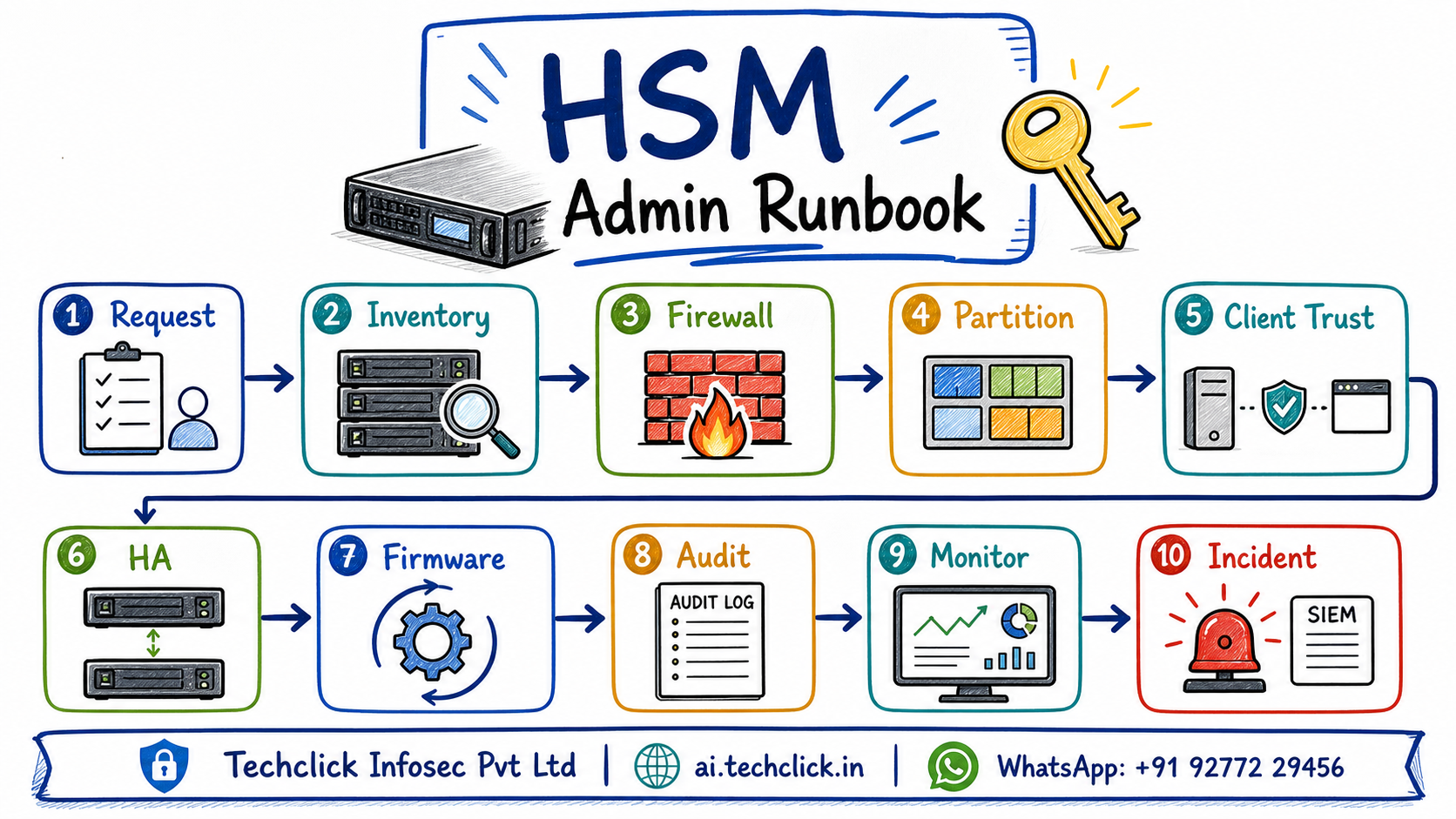
1. Convert the JD into daily HSM operations
For a Thales Luna Network HSM administrator, the job starts before a key is created. You maintain an inventory of appliances, serial numbers, firmware versions, partitions, client owners, allowed source IPs, backup status, HA membership and compliance mode. That inventory is the difference between controlled cryptography and a mystery box in the data center.
Production request flow: application owner raises a crypto requirement, security approves purpose and key type, network team opens the minimum path, HSM admin creates or assigns a partition, client trust is registered, the app team tests PKCS#11/JCE/CNG integration, and audit logs prove the final operation.
Weak answer: "I know HSM stores keys." Strong answer: "I can onboard an application to a Luna partition with owner, firewall, certificate, policy, HA, monitoring and audit evidence."
Pause & Predict
A new payment application asks for HSM access. Which two approvals must exist before you create or assign keys?
What is the strongest way to explain this HSM admin JD?
2. Luna architecture objects you must name
The useful mental model is layered: appliance for network and management access, cryptographic module for secure key operations, application partition for tenant/application separation, client for the application host, and HA group when application uptime cannot depend on one physical HSM.
- LunaSH - appliance and HSM administration from the HSM appliance side.
- LunaCM - client-side tool used by administrators and application hosts to manage client and partition operations.
- Application partition - logical container for keys and crypto objects; it can be dedicated to one client or shared by multiple approved clients.
- NTLS/STC - secure client-to-HSM communication models that must match firewall and certificate trust design.
- Audit and monitoring - syslog, SNMP, events, partition evidence and SIEM mapping for operations and compliance.
A partition is not just a folder. Treat it as an application or tenant boundary for key material, policy and audit evidence.
Firewall requests need source, destination, protocol, port, purpose, owner and review date. Guessing ports is not HSM administration.
An HA group is only useful when failover, client behavior, key availability and application transaction tests have been proven.
For regulated crypto operations, the log trail is part of the control. If it is not recorded and reviewed, it is not operationally mature.
Which Luna object is the normal boundary for application key material?
3. Onboard one application without guessing
When a payment, PKI, TLS, signing or secrets-management application asks for HSM access, do not start with commands. Start with scope. Which environment, which app owner, which key type, which crypto API, which source servers, which destination HSMs, which ports, which partition and which compliance boundary?
Firewall request checklist: source hostnames/IPs, HSM management versus client path, protocol, port, environment, business owner, change ticket, test window, rollback owner and expiry/review date. For interview purposes, say clearly that management access and application crypto access are not the same trust path.
Integration checklist: Luna Client installed, client certificate generated and registered, partition visible, policy permits the needed operation, app uses the expected provider/library, HA group tested where required, and audit logs show the expected key operation.
Pause & Predict
Firewall reachability is open, but LunaCM still does not show the expected partition. What do you check before touching the key?
Treat network access to an HSM like privileged access. Scope source, destination, protocol, purpose, owner and expiry instead of opening broad network ranges.
Watch the Thales Luna application onboarding path
Press Play for the healthy path, then Break it for a firewall/client trust failure.
A new app cannot see the HSM partition. What should you check early?
4. Firmware, HA and compliance without outage drama
Firmware and appliance updates are where HSM administrators show discipline. The safe sequence is: read customer release notes, confirm target firmware and client compatibility, check backups, confirm HA member health, schedule application owner testing, stop or drain traffic for the member being updated, verify secure package/authentication code, update, validate, then repeat for the next member only after evidence is clean.
Thales documents call out update cautions such as UPS protection, checking release notes and stopping client applications for firmware package update workflows. In a bank or payment environment, your answer should include change approval, dual control where required, rollback evidence, and post-change crypto transaction tests.
Compliance angle: FIPS 140-3 validation, NIST SP 800-57 key-management guidance, PCI/PIN expectations, ISO 27001 audit control, HIPAA/GDPR privacy scope and local regulatory evidence all map back to the same evidence set: key ownership, access control, lifecycle, backup/recovery, logging and review.
Pause & Predict
During a firmware window, one HA member passes appliance health but the app still times out. What evidence decides whether to continue?
Do not upgrade firmware because a newer version exists. Read release notes, prove backup and HA health, involve app owners and test actual cryptographic transactions.
5. Incidents, monitoring and interview evidence
HSM monitoring is not just CPU and memory. Watch HSM health, partition availability, HA member state, syslog/audit events, authentication failures, failed crypto operations, unusual key-generation volume, certificate/client changes, firmware drift, backup failures and application error spikes.
Incident example: a signing service suddenly fails with CKR_DEVICE_ERROR or timeout. Do not reboot first. Check app logs, Luna Client visibility, network path, partition login state, HA member status, HSM event logs, recent firewall or certificate changes, and whether another application is exhausting sessions or crypto capacity.
Interview close: "I would prove the layer that failed, fix the smallest safe change, capture before/after logs, update the inventory/change record, and brief app, security and audit owners." That is the HSM administrator mindset.
Priya at a Mumbai payments company gets this ticket
The card PIN service intermittently times out after a weekend HSM change.
One HA member was updated and returned to service before client, partition and application transaction checks were completed.
Trace app error time, client visibility, HA member state, partition login, firewall path, syslog/audit event and recent change record.
App logs -> Luna Client visibility -> HA group -> partition -> HSM syslog/audit -> change ticketDrain the suspect member, validate firmware/client compatibility, restore clean HA state, rerun PIN transaction tests and document the evidence.
Show a successful app transaction, healthy HA member status, expected audit event and updated change/inventory record.
For HSM incidents, evidence should include app error, HSM/client state, log timestamp, affected partition and the exact change that fixed the issue.
Best close to an HSM incident response answer?
🤖 Ask the AI Tutor
Tap any question — instant, scoped to this lesson. No login, no waiting.
Pre-curated from vendor docs + community Q&A, scoped to this lesson. For a live prod issue, paste your export into chat.techclick.in.
📝 Wrap-up assessment — six more
You've answered 4 inline. Six left. 70% (7 of 10) marks the lesson complete on your profile. Tap Submit all answers at the end.
🧠 In your own words
Explain Thales Luna HSM administration in one L2 interview sentence.
🗣 Teach a friend
Best way to lock it in — explain it in one line to a teammate. Tap to generate a paste-ready summary.
📖 Glossary
- HSM
- Hardware Security Module; tamper-resistant hardware used to protect keys and perform cryptographic operations.
- Application partition
- A logical Luna boundary where approved clients store and use cryptographic objects.
- LunaSH
- Thales Luna appliance-side shell for administration tasks.
- LunaCM
- Client-side management tool used with Luna HSM Client.
- NTLS/STC
- Secure communication models for client-to-HSM connectivity that must match trust and firewall design.
- FIPS 140-3
- Cryptographic module validation standard managed through CMVP and aligned with ISO/IEC 19790.
📚 Sources
- Thales Luna Network HSM 7 Product Documentation
- Thales - Installing and Configuring Luna Network HSM 7
- Thales - Luna Hardware Security Modules overview
- Thales - High-Availability Groups
- Thales - Updating the Luna HSM Firmware
- Thales - FIPS 140-3 validation for Luna HSMs
- NIST SP 800-57 Part 1 Rev. 5 - Recommendation for Key Management
- NIST CMVP - FIPS 140-3 Standards
What's next?
Next vendor lane: build the same operations playbook for Entrust nShield or Utimaco so learners can compare partition, quorum, audit and HA models without mixing vendor commands.