Start here · learn the idea before the technical detail
What you are learning
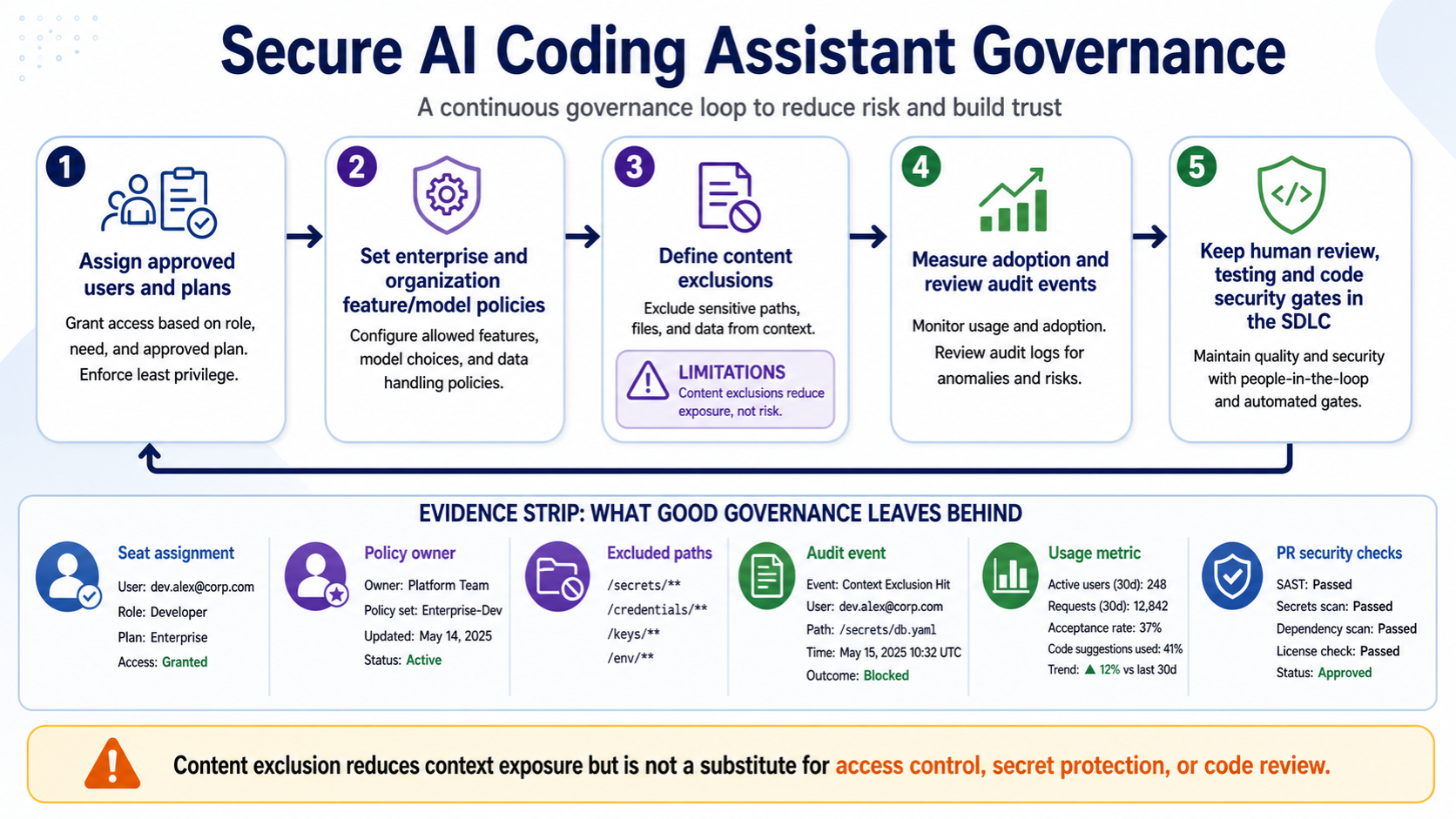
This lesson makes AI coding-assistant governance practical. The goal is not to block every suggestion. It is to decide who may use the tool, which features and models are allowed, what context should be reduced, how usage is reviewed, and which human and automated checks remain mandatory.
In plain English
Governance combines access, enterprise policy, data-handling choices, monitoring, and normal software security controls. Content exclusion can reduce which files are offered as context, but it has limitations and must not be treated as a complete security boundary.
Real example
A company gives approved developers access to an enterprise plan, limits selected features, excludes sensitive paths where supported, reviews usage and audit evidence, and still requires pull-request review, testing, secret scanning, and code scanning before merge.
Follow this flow
- Assign an owner and define the approved users and use cases.
- Configure enterprise and organisation policies for features and models.
- Set content exclusions where useful and document their limitations.
- Teach developers not to paste secrets or unapproved sensitive data.
- Review adoption metrics and audit events for unusual patterns.
- Keep human review, testing, and security gates in the delivery workflow.
Evidence to collect
- Seat assignment and approved user
- Policy owner, policy state, and change date
- Configured excluded paths
- Usage metrics and relevant audit events
- Pull-request review and security-check results
Common mistake to avoid
Do not tell students that content exclusion guarantees a sensitive file can never influence a suggestion. GitHub documents limitations. Use it to reduce exposure while keeping access control, secret protection, developer guidance, review, and testing.
Current official source checkpoint
- GitHub Copilot policiesofficial reference checked for this explanation
- GitHub Copilot content exclusionofficial reference checked for this explanation
- Review content exclusion changesofficial reference checked for this explanation
- GitHub Copilot metricsofficial reference checked for this explanation
Key terms before you continue
Most engineers think...
Most candidates describe Secure AI coding assistant governance as a product name and stop there. That is not enough for L2/L3 work.
The better model is operational: know the components, follow the flow, prove the policy hit, and explain the failure path. For this topic, the core idea is Assistant policy and Content exclusion.
① What it solves and where it sits
AI coding assistants are becoming part of developer workflow, but they need repository scope, prompt/data rules, generated-code review, secret controls and policy for regulated projects.
Production use case: Use it when engineering teams want productivity from Copilot-style tools without leaking code, secrets or unsafe generated patterns.
Best one-line description of Secure AI coding assistant governance?
② Core components you must name
Use these names before jumping to troubleshooting. They anchor the architecture and make the interview answer sound practical.
- Assistant policy — Who can use the tool, where and under what repository rules
- Content exclusion — Repository or path controls that restrict sensitive context
- Secret scanning — Detection for generated or pasted secrets before commit
- Review gate — Human and automated security review for generated changes
- Audit trail — Enterprise usage, policy and security-event evidence
Say the path in order: Enable policy → Limit context → Generate code → Scan changes → Review merge. It keeps the answer structured.
A decision is not real until logs/events show the rule, object and final action.
Most outages are not product magic; they are forwarding, health, identity, certificate or rule-order problems.
Safe rollout: Pilot discovery in monitor mode, validate owners and evidence, then enforce on a small ring before broad rollout..
Lead with Assistant policy, Content exclusion, Secret scanning. It sounds like production work, not brochure reading.
Which item belongs in the core architecture?
③ The traffic or telemetry path
The healthy path is: Enable policy → Limit context → Generate code → Scan changes → Review merge. Walk it left to right. If a user report says 'it is broken', locate the exact stage where evidence stops.
The primary control is: Use Assistant policy and Content exclusion to make a scoped security decision and prove it with logs or policy evidence..
If Enable policy never reaches the control point, no later policy can help. Confirm steering/forwarding first.
▶ Watch the Secure AI coding assistant governance decision path
Press Play for the healthy path, then Break it for the common outage.
What should you trace first during troubleshooting?
④ Operations, rollout and interview response
The safe rollout answer is: Pilot discovery in monitor mode, validate owners and evidence, then enforce on a small ring before broad rollout.. That prevents broad production impact while still moving toward enforcement.
Compared with unreviewed generated code, the value is richer policy context, better visibility and a clearer operational evidence trail.
Rohan at a Noida SOC gets this ticket
A developer accepts generated code that logs credentials during debugging and commits it to a private repo.
The rollout enabled the assistant but did not require secret scanning, code review, sensitive-path exclusion or secure coding checks.
Trace Enable policy → Limit context → Generate code → Scan changes → Review merge, then compare policy logs, object health and user scope.
Console ▸ policy/logs ▸ health/status ▸ affected user testApply assistant policy, exclude sensitive paths, run secret and SAST checks, require reviewer approval and document approved use cases.
Repeat the original user test and capture the allow/block/health evidence in logs.
The final answer should include log evidence, health state and a user test. That is what separates RCA from guessing.
Safest production rollout answer?
🤖 Ask the AI Tutor
Tap any question — instant, scoped to this lesson. No login, no waiting.
Pre-curated from vendor docs + community Q&A, scoped to this lesson. For a live prod issue, paste your export into chat.techclick.in.
📝 Wrap-up assessment — six more
You've answered 4 inline. Six left. 70% (7 of 10) marks the lesson complete on your profile. Tap Submit all answers at the end.
🧠 In your own words
Explain Secure AI coding assistant governance in one L2 interview sentence.
🗣 Teach a friend
Best way to lock it in — explain it in one line to a teammate. Tap to generate a paste-ready summary.
📖 Glossary
- Assistant policy
- Who can use the tool, where and under what repository rules
- Content exclusion
- Repository or path controls that restrict sensitive context
- Secret scanning
- Detection for generated or pasted secrets before commit
- Review gate
- Human and automated security review for generated changes
- Audit trail
- Enterprise usage, policy and security-event evidence
- Evidence trail
- Logs, policy state, ownership, health and retest data used to prove the decision.
📚 Sources
What's next?
Next, pair this lesson with the new Secure AI coding assistant governance interview Q&A page and explain the same flow out loud in 90 seconds.