Most engineers think...
Most candidates describe Imperva DDoS GRE BGP Clean Traffic Architecture as a product name and stop there. That is not enough for L2/L3 work.
The better model is operational: know the components, follow the flow, prove the policy hit, and explain the failure path. For this topic, the core idea is BGP/GRE scrubbing architecture with clean-traffic return.
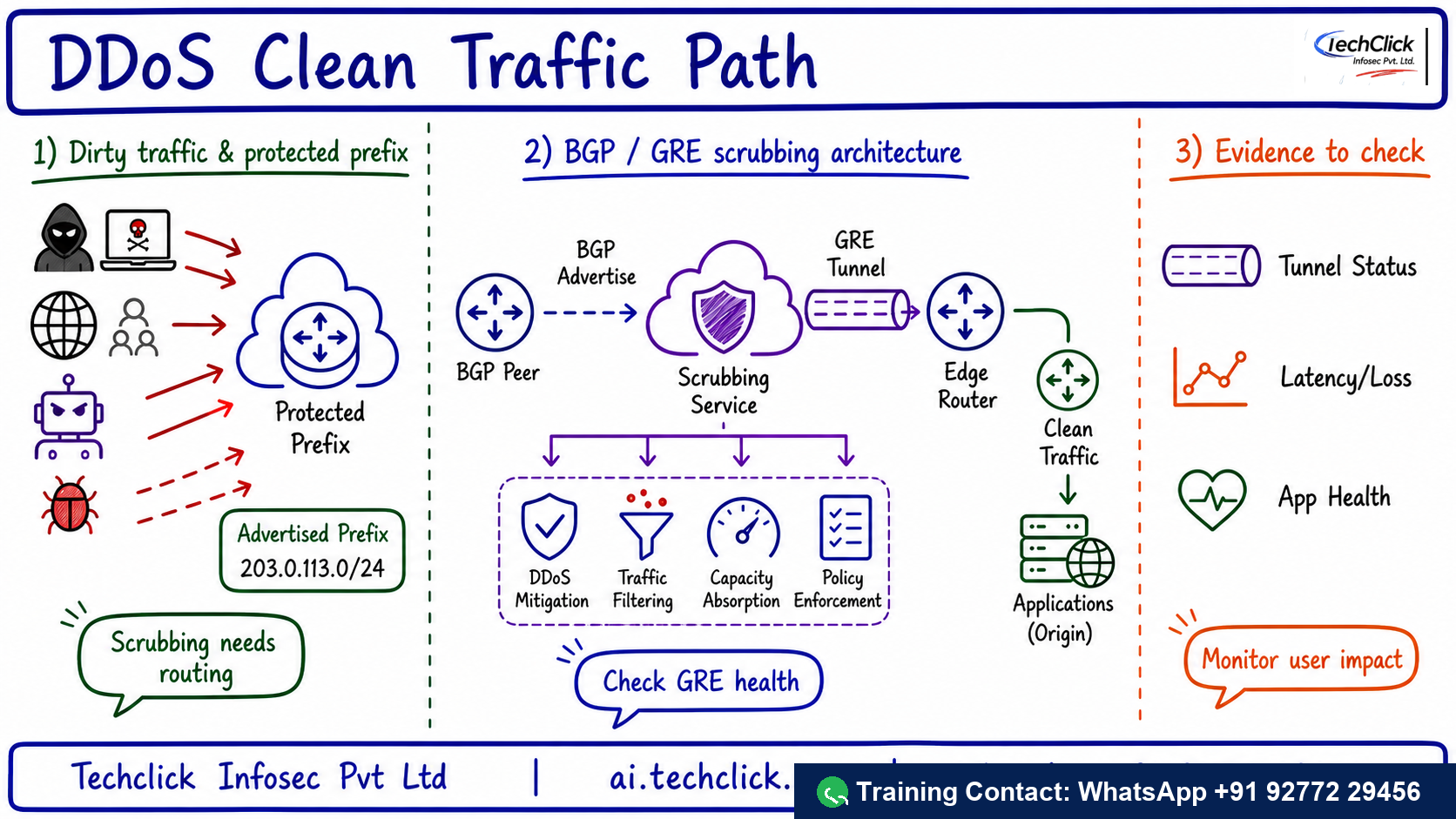
① What it solves and where it sits
If BGP or GRE is wrong, the scrubber may work but the application still fails. The runbook must include route state and clean-traffic path.
Production use case: Use it for network-layer DDoS planning, on-demand activation and post-attack RCA.
Best one-line description of Imperva DDoS GRE BGP Clean Traffic Architecture?
② Core components you must name
Use these names before jumping to troubleshooting. They anchor the architecture and make the interview answer sound practical.
- BGP peer — Routing relationship used to advertise protected prefixes
- Advertised prefix — Network range sent toward mitigation
- GRE tunnel — Clean-traffic return path from scrubbing
- Scrubbing service — Filters volumetric and protocol attack traffic
- Latency/loss — User-impact evidence during mitigation
Say the path in order: Advertise prefix → Divert traffic → Scrub attack → Return clean → Monitor app. It keeps the answer structured.
A decision is not real until logs/events show the rule, object and final action.
Most outages are not product magic; they are forwarding, health, identity, certificate or rule-order problems.
Safe rollout: Test peering and GRE before an attack, rehearse route-on/route-off, document prefixes and monitor latency during drills.
Lead with BGP peer, Advertised prefix, GRE tunnel. It sounds like production work, not brochure reading.
Which item belongs in the core architecture?
③ The traffic or telemetry path
The healthy path is: Advertise prefix → Divert traffic → Scrub attack → Return clean → Monitor app. Walk it left to right. If a user report says 'it is broken', locate the exact stage where evidence stops.
The primary control is: Validate BGP peer state, advertised prefixes, GRE endpoint, tunnel status, latency/loss and clean route.
If Advertise prefix never reaches the control point, no later policy can help. Confirm steering/forwarding first.
▶ Watch the Imperva DDoS GRE BGP Clean Traffic Architecture decision path
Press Play for the healthy path, then Break it for the common outage.
What should you trace first during troubleshooting?
④ Operations, rollout and interview response
The safe rollout answer is: Test peering and GRE before an attack, rehearse route-on/route-off, document prefixes and monitor latency during drills. That prevents broad production impact while still moving toward enforcement.
Compared with portal-only DDoS activation, the value is richer policy context, better visibility and a clearer operational evidence trail.
Rohan at a Noida SOC gets this ticket
Attack traffic drops but users still see intermittent timeouts.
The DDoS team validated scrubbing but not GRE tunnel health or clean-route symmetry.
Trace Advertise prefix → Divert traffic → Scrub attack → Return clean → Monitor app, then compare policy logs, object health and user scope.
Console ▸ policy/logs ▸ health/status ▸ affected user testCheck BGP state, GRE health, route tables, latency/loss and app logs before changing mitigation thresholds.
Repeat the original user test and capture the allow/block/health evidence in logs.
The final answer should include log evidence, health state and a user test. That is what separates RCA from guessing.
Safest production rollout answer?
🤖 Ask the AI Tutor
Tap any question — instant, scoped to this lesson. No login, no waiting.
Pre-curated from vendor docs + community Q&A, scoped to this lesson. For a live prod issue, paste your export into chat.techclick.in.
📝 Wrap-up assessment — six more
You've answered 4 inline. Six left. 70% (7 of 10) marks the lesson complete on your profile. Tap Submit all answers at the end.
🧠 In your own words
Explain Imperva DDoS GRE BGP Clean Traffic Architecture in one L2 interview sentence.
🗣 Teach a friend
Best way to lock it in — explain it in one line to a teammate. Tap to generate a paste-ready summary.
📖 Glossary
- Cloud WAF
- Imperva edge-delivered WAF service for web application and API protection.
- WAF Gateway
- Imperva local gateway option for environments that need local control or sovereignty.
- API discovery
- The process of finding documented, undocumented, public, private and shadow APIs.
- Client classification
- Bot-control evidence that separates likely users, bots, tools and abusive automation.
- Clean traffic
- Traffic returned from a DDoS scrubbing path after malicious traffic is filtered.
- DRA
- Data Risk Analytics, the Imperva DSF risk layer for database and data activity.
📚 Sources
What's next?
Next, pair this lesson with the new Imperva DDoS GRE BGP Clean Traffic Architecture interview Q&A page and explain the same flow out loud in 90 seconds.