Weak answer vs real interview answer
A weak answer says only: 'F5 BIG-IP LTM Deep Dive is important for F5.' That is not enough for a learner, interview panel or production bridge call.
A strong answer connects product objects, evidence and risk: F5 positions LTM as the BIG-IP traffic-management foundation for availability, SSL acceleration, analytics, iRules programmability and full proxy control. Then it proves the decision with virtual server status, destination and VLAN enablement, profile chain, pool member monitor result, load-balancing method, SNAT translation, persistence record, clientssl/serverssl handshake, tcpdump on 0.0 and /var/log/ltm.
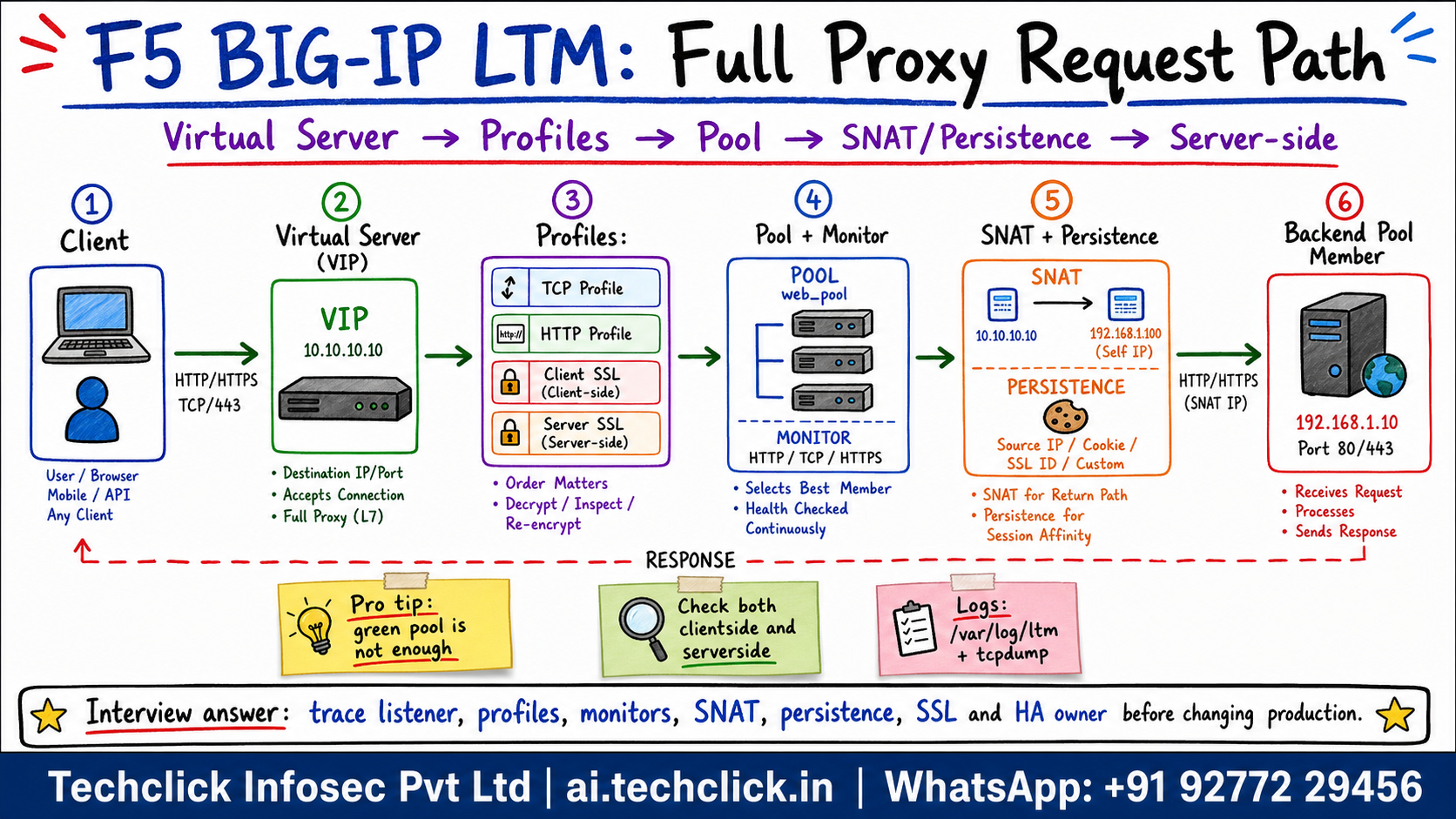
① Why F5 BIG-IP LTM Deep Dive matters in production
Most LTM issues are not solved by saying 'pool member down'. Engineers must know where the full proxy flow breaks: listener, route, profile, monitor, SNAT, persistence, SSL or HA ownership.
F5-specific angle: F5 positions LTM as the BIG-IP traffic-management foundation for availability, SSL acceleration, analytics, iRules programmability and full proxy control.
Do not say: Assume a green pool means the application is reachable for users. That answer skips the evidence path that makes the decision defensible.
For F5 BIG-IP LTM Deep Dive, what makes an answer production-ready?
② Product objects and evidence you must name
Name the F5 objects first, then name the evidence. That is what separates a real engineer answer from brochure language.
- Virtual server - The client-facing listener: destination IP:port plus VLAN, protocol, profiles and default pool.
- Pool and member - The service targets; monitors decide whether each member can receive traffic.
- Profiles - Protocol behavior: TCP, HTTP, clientssl, serverssl, OneConnect, compression and more.
- SNAT - Source translation so backend replies return through the BIG-IP when routing is asymmetric.
- Traffic group - The floating ownership unit that moves virtual addresses during HA failover.
Evidence to ask for: virtual server status, destination and VLAN enablement, profile chain, pool member monitor result, load-balancing method, SNAT translation, persistence record, clientssl/serverssl handshake, tcpdump on 0.0 and /var/log/ltm.
The client-facing listener: destination IP:port plus VLAN, protocol, profiles and default pool.
The service targets; monitors decide whether each member can receive traffic.
Protocol behavior: TCP, HTTP, clientssl, serverssl, OneConnect, compression and more.
Source translation so backend replies return through the BIG-IP when routing is asymmetric.
For F5 BIG-IP LTM Deep Dive, start with the object that makes the decision. Then move to logs, counters and packet/session evidence.
Which evidence set is strongest for F5 BIG-IP LTM Deep Dive?
③ Scenario path - where the issue actually breaks
Healthy path: Client VIP -> Profiles -> Pool select -> SNAT/persist -> Server side. In a live issue, walk the flow from left to right and stop where evidence disappears.
Scenario: Users get intermittent 502 errors after a new HTTPS virtual server goes live; pool members are green and the app team says the servers are fine.
Likely root cause: The virtual server terminates client SSL but the serverside SSL profile is missing, so the BIG-IP sends clear HTTP to a backend that expects TLS.
Diagnosis: Compare clientside and serverside tcpdump, check virtual server profiles, then test the pool member directly on 443.
Neha at a Mumbai fintech faces this
Users get intermittent 502 errors after a new HTTPS virtual server goes live; pool members are green and the app team says the servers are fine.
The virtual server terminates client SSL but the serverside SSL profile is missing, so the BIG-IP sends clear HTTP to a backend that expects TLS.
Compare clientside and serverside tcpdump, check virtual server profiles, then test the pool member directly on 443.
Local Traffic > Virtual Servers > VS_APP_443 > Profiles + tmsh show ltm virtual/pool + tcpdump -ni 0.0 hostAttach the correct serverssl profile, confirm SNI/ciphers if required, test one transaction, then monitor server-side resets and HTTP response codes.
Repeat the original user path, check the relevant F5 logs/counters, and confirm the owner sees the expected application result.
A green object can still fail for real users if the wrong profile, route, policy branch, DNS answer, SSL behavior or cache state is in play.
Watch one HTTPS request cross LTM
Press Play to follow the full proxy path, then Break it to see the classic SSL-profile mistake.
Users get intermittent 502 errors after a new HTTPS virtual server goes live; pool members are green and the app team says the servers are fine.
④ Interview answer, remediation and verification
Model answer: I would not start with pool replacement. I would prove the VIP is listening, profiles are correct, pool members are truly reachable, SNAT return path is valid, persistence is not pinning users to a bad member, and SSL is correct on both sides.
Fix path: Attach the correct serverssl profile, confirm SNI/ciphers if required, test one transaction, then monitor server-side resets and HTTP response codes.
Unsafe shortcut to avoid: Change the pool or reboot members before proving whether the break is clientside, BIG-IP, or serverside.
A good Techclick answer ends with the exact proof: log entry, counter, packet capture, session variable, DNS answer, support ID or user transaction.
What is the safest remediation mindset for F5 BIG-IP LTM Deep Dive?
🤖 Ask the AI Tutor
Tap any question — instant, scoped to this lesson. No login, no waiting.
Pre-curated from vendor docs + community Q&A, scoped to this lesson. For a live prod issue, paste your export into chat.techclick.in.
📝 Wrap-up assessment — six more
You've answered 4 inline. Six left. 70% (7 of 10) marks the lesson complete on your profile. Tap Submit all answers at the end.
🧠 In your own words
Type one line: what makes F5 BIG-IP LTM Deep Dive different from a generic F5 answer? Then compare with the expert version.
🗣 Teach a friend
Best way to lock it in — explain it in one line to a teammate. Tap to generate a paste-ready summary.
📖 Glossary
- Virtual server
- A BIG-IP listener represented by destination IP, service port, protocol, profiles and traffic policy.
- Pool member
- A specific node and service port that can receive application traffic.
- Monitor
- The health check that decides whether a pool member is eligible for load balancing.
- SNAT
- Source Network Address Translation used to keep return traffic symmetric through BIG-IP.
- Persistence
- A stickiness method that sends related requests to the same pool member.
- Client SSL
- The SSL profile that terminates TLS from the client to BIG-IP.
- Server SSL
- The SSL profile used when BIG-IP encrypts traffic toward the backend server.
- Traffic group
- The floating HA object that owns virtual addresses and fails over between devices.
📚 Sources
- F5 - BIG-IP Local Traffic Manager product page. https://www.f5.com/products/big-ip-services/local-traffic-manager
- F5 TechDocs - Introduction to Local Traffic Manager. https://techdocs.f5.com/kb/en-us/products/big-ip_ltm/manuals/product/ltm-concepts-11-5-1/2.html
- F5 TechDocs - About Virtual Servers. https://techdocs.f5.com/kb/en-us/products/big-ip_ltm/manuals/product/ltm-basics-11-6-0/2.html
- F5 TechDocs - About Pools. https://techdocs.f5.com/kb/en-us/products/big-ip_ltm/manuals/product/ltm-basics-11-6-0/4.html
- F5 TechDocs - Services profiles reference. https://techdocs.f5.com/en-us/bigip-14-1-0/big-ip-local-traffic-management-profiles-reference-14-1-0/services-profiles.html
- F5 TechDocs - Managing connection mirroring. https://techdocs.f5.com/kb/en-us/products/big-ip_ltm/manuals/product/bigip-device-service-clustering-admin-11-5-0/9.html
What's next?
Next, explain an LTM outage in 90 seconds: VIP listener, pool health, SNAT path, persistence, SSL profile and traffic-group owner.