Weak answer vs real interview answer
A weak answer says only: 'F5 APM and BIG-IP Zero Trust Access is important for F5.' That is not enough for a learner, interview panel or production bridge call.
A strong answer connects product objects, evidence and risk: F5 now presents BIG-IP Zero Trust Access as the successor branding for APM, with identity-aware proxy, SSO/federation, OAuth/OIDC, MFA, dynamic split tunneling, IPSec VPN and policy-based access. Then it proves the decision with access session ID, /var/log/apm, VPE branch result, AAA server response, session variables, group mapping, resource assignment, SSO credential mapping, policy ending, per-request policy and backend HTTP status.
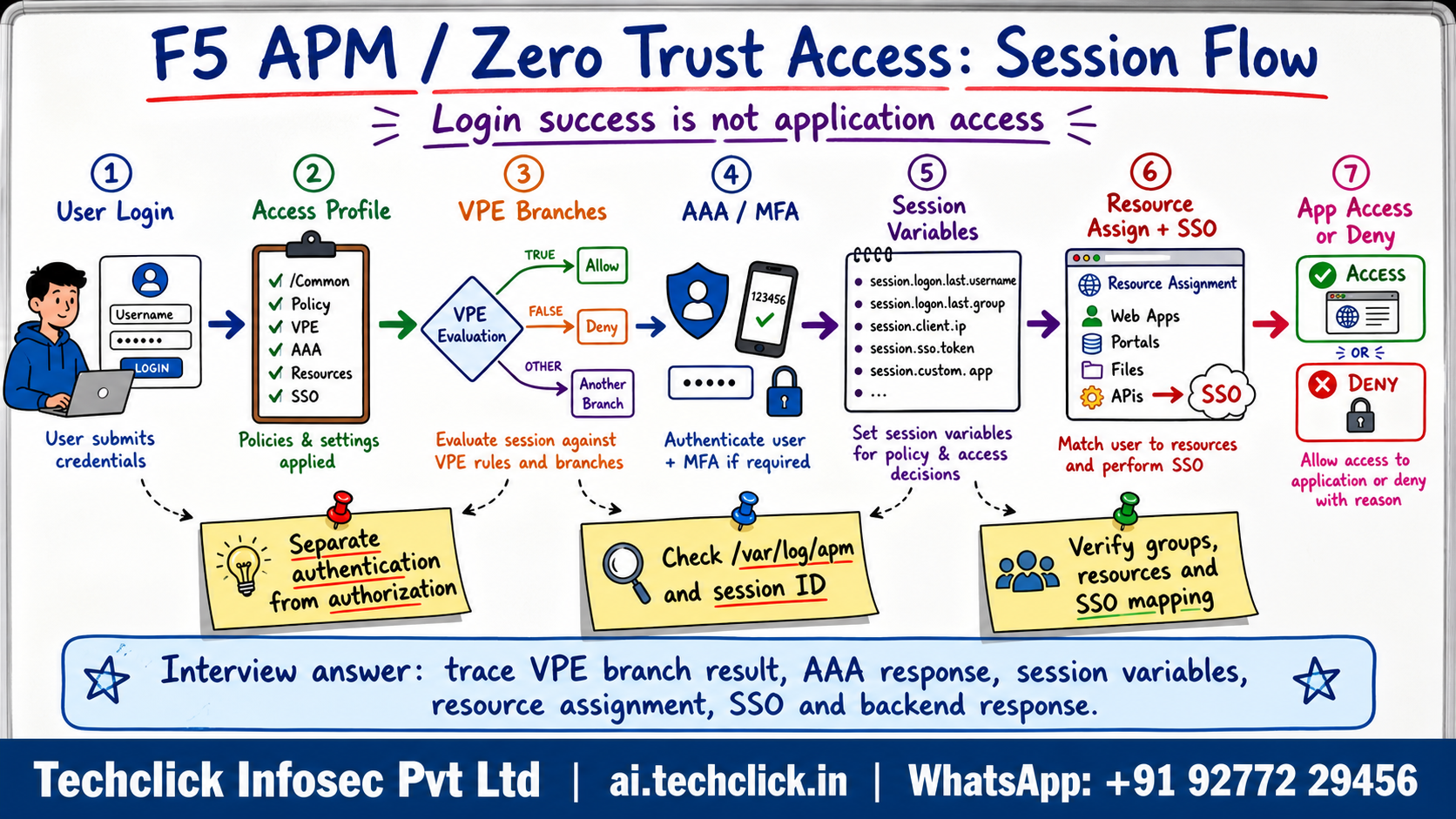
① Why F5 APM and BIG-IP Zero Trust Access matters in production
APM failures are painful because users just see access denied or VPN failure. A real engineer traces policy branches, AAA responses, session variables, resource assignment and backend SSO evidence.
F5-specific angle: F5 now presents BIG-IP Zero Trust Access as the successor branding for APM, with identity-aware proxy, SSO/federation, OAuth/OIDC, MFA, dynamic split tunneling, IPSec VPN and policy-based access.
Do not say: Assume authentication succeeded just because the login page accepted the username. That answer skips the evidence path that makes the decision defensible.
For F5 APM and BIG-IP Zero Trust Access, what makes an answer production-ready?
② Product objects and evidence you must name
Name the F5 objects first, then name the evidence. That is what separates a real engineer answer from brochure language.
- Access profile - The object attached to a virtual server that starts an APM secured session.
- VPE - The Visual Policy Editor where per-session decisions, AAA and resource assignment are built.
- AAA - Authentication, authorization and accounting servers such as AD, LDAP, RADIUS, SAML or OIDC.
- Session variables - Runtime values such as username, groups, client IP, endpoint posture and policy results.
- Resource assign - The policy step that grants portal, network, application tunnel or SSO resources.
Evidence to ask for: access session ID, /var/log/apm, VPE branch result, AAA server response, session variables, group mapping, resource assignment, SSO credential mapping, policy ending, per-request policy and backend HTTP status.
The object attached to a virtual server that starts an APM secured session.
The Visual Policy Editor where per-session decisions, AAA and resource assignment are built.
Authentication, authorization and accounting servers such as AD, LDAP, RADIUS, SAML or OIDC.
Runtime values such as username, groups, client IP, endpoint posture and policy results.
For F5 APM and BIG-IP Zero Trust Access, start with the object that makes the decision. Then move to logs, counters and packet/session evidence.
Which evidence set is strongest for F5 APM and BIG-IP Zero Trust Access?
③ Scenario path - where the issue actually breaks
Healthy path: Logon -> AAA -> Policy branch -> Assign -> App access. In a live issue, walk the flow from left to right and stop where evidence disappears.
Scenario: Only contractors from one AD group can log in, but they land on a blank portal page and no application icons appear.
Likely root cause: Authentication succeeds, but the resource assign or group mapping branch does not match the contractor group.
Diagnosis: Open the access session details and inspect session.ad.last.attr.memberOf, branch rules, assigned resources and SSO mapping.
Neha at a Mumbai fintech faces this
Only contractors from one AD group can log in, but they land on a blank portal page and no application icons appear.
Authentication succeeds, but the resource assign or group mapping branch does not match the contractor group.
Open the access session details and inspect session.ad.last.attr.memberOf, branch rules, assigned resources and SSO mapping.
Access > Overview > Active Sessions + Access > Profiles / Policies > Access Profiles > Edit in Visual Policy EditorCorrect the group branch or resource assign object, test with one contractor account, verify the portal resource and backend SSO are both assigned.
Repeat the original user path, check the relevant F5 logs/counters, and confirm the owner sees the expected application result.
A green object can still fail for real users if the wrong profile, route, policy branch, DNS answer, SSL behavior or cache state is in play.
Watch one APM session earn application access
Press Play to follow the VPE flow, then Break it to see the group-mapping failure.
Only contractors from one AD group can log in, but they land on a blank portal page and no application icons appear.
④ Interview answer, remediation and verification
Model answer: I separate authentication from authorization. Login success only proves AAA. I still need to prove branch selection, session variables, resource assignment, SSO mapping and backend response.
Fix path: Correct the group branch or resource assign object, test with one contractor account, verify the portal resource and backend SSO are both assigned.
Unsafe shortcut to avoid: Bypass the access policy or add contractors to a broad employee group just to make the portal appear.
A good Techclick answer ends with the exact proof: log entry, counter, packet capture, session variable, DNS answer, support ID or user transaction.
What is the safest remediation mindset for F5 APM and BIG-IP Zero Trust Access?
🤖 Ask the AI Tutor
Tap any question — instant, scoped to this lesson. No login, no waiting.
Pre-curated from vendor docs + community Q&A, scoped to this lesson. For a live prod issue, paste your export into chat.techclick.in.
📝 Wrap-up assessment — six more
You've answered 4 inline. Six left. 70% (7 of 10) marks the lesson complete on your profile. Tap Submit all answers at the end.
🧠 In your own words
Type one line: what makes F5 APM and BIG-IP Zero Trust Access different from a generic F5 answer? Then compare with the expert version.
🗣 Teach a friend
Best way to lock it in — explain it in one line to a teammate. Tap to generate a paste-ready summary.
📖 Glossary
- Access profile
- The APM object selected on a virtual server to start a secured session.
- VPE
- Visual Policy Editor, the graphical builder for access-policy branches.
- AAA server
- Authentication or authorization source such as AD, LDAP, RADIUS, SAML or OIDC.
- Session variable
- A runtime value used by APM policy logic and resource assignment.
- Resource assign
- The policy action that grants portal, network, application, webtop or SSO resources.
- Webtop
- The portal page showing the resources a user is allowed to access.
- SSO mapping
- The credential or token handoff from APM to the backend application.
- Per-request policy
- Policy logic evaluated on individual HTTP requests after session creation.
📚 Sources
- F5 - BIG-IP Zero Trust Access product page. https://www.f5.com/products/big-ip-services/zero-trust-access
- F5 Blog - Hello, F5 BIG-IP Zero Trust Access. Long live F5 BIG-IP APM!. https://www.f5.com/company/blog/hello-f5-big-ip-zero-trust-access-long-live-f5-big-ip-apm
- F5 TechDocs - Introducing BIG-IP Access Policy Manager. https://techdocs.f5.com/kb/en-us/products/big-ip_apm/manuals/product/apm-config-11-4-0/apm_config_intro.html
- F5 TechDocs - Creating Access Profiles and Access Policies. https://techdocs.f5.com/kb/en-us/products/big-ip_apm/manuals/product/apm-config-11-4-0/apm_config_creatingpolicies.html
- F5 TechDocs - Visual Policy Editor. https://techdocs.f5.com/en-us/bigip-14-1-0/big-ip-access-policy-manager-visual-policy-editor-14-1-0/visual-policy-editor.html
- F5 TechDocs - Session Variables. https://techdocs.f5.com/kb/en-us/products/big-ip_apm/manuals/product/apm-config-11-4-0/apm_config_sessionvars.html
What's next?
Next, draw the VPE path from logon page to AAA, group lookup, resource assignment, SSO and deny branch.