Weak answer vs real interview answer
A weak answer says only: 'F5 Advanced WAF and ASM Policy Tuning is important for F5.' That is not enough for a learner, interview panel or production bridge call.
A strong answer connects product objects, evidence and risk: F5 describes Advanced WAF as policy-driven protection with OWASP Top 10 dashboards, guided configuration, a learning engine, custom policy building, API protection, behavioral DoS and attack-signature controls. Then it proves the decision with support ID, request log, matched violation, signature ID and staging state, URL/file type/parameter entity, enforcement mode, learning suggestion, policy diff, false-positive reproduction and post-change event count.
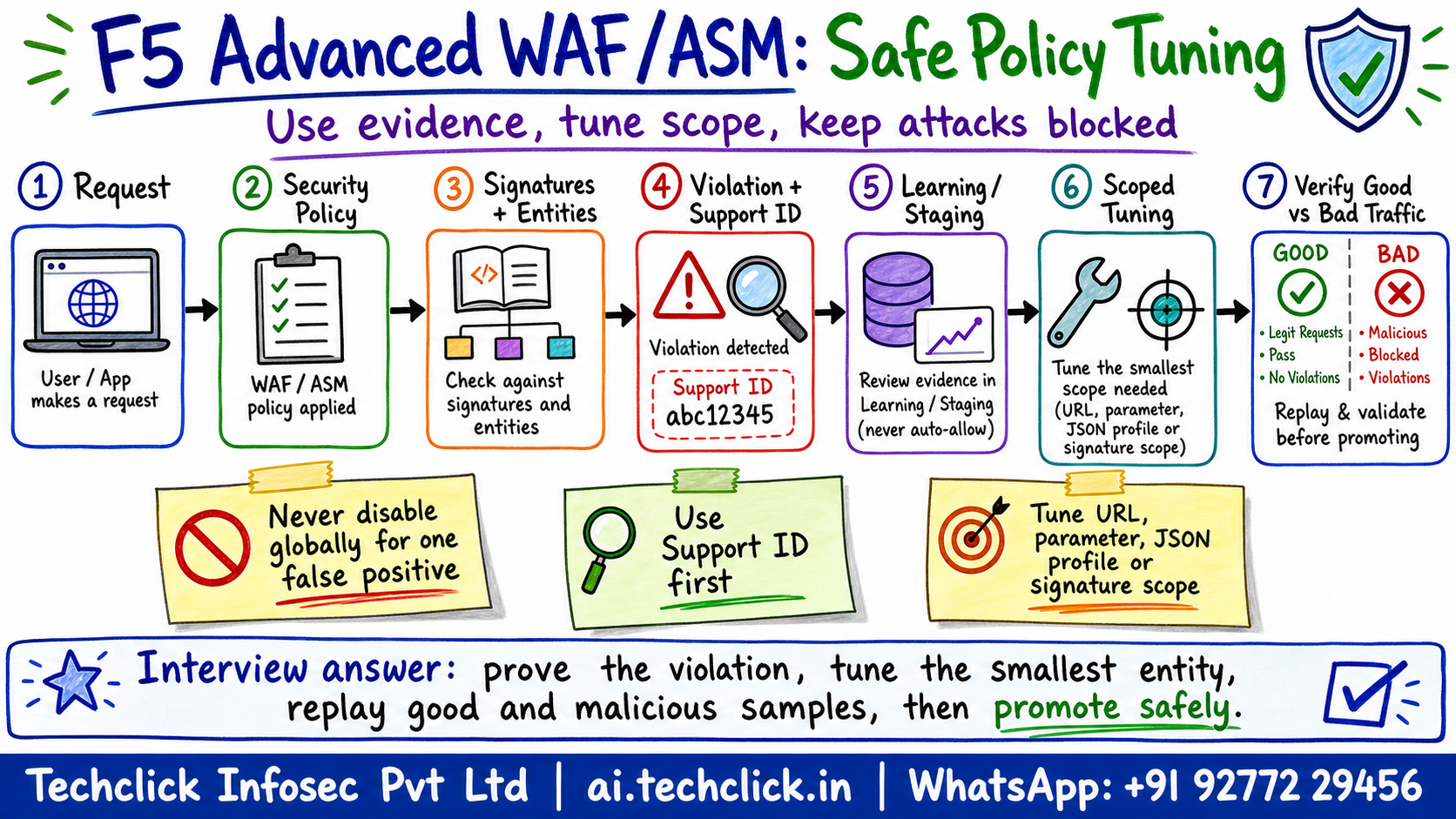
① Why F5 Advanced WAF and ASM Policy Tuning matters in production
WAF content is often shallow because it lists OWASP attacks but does not teach how a real F5 policy is built, staged, tuned and moved safely to blocking.
F5-specific angle: F5 describes Advanced WAF as policy-driven protection with OWASP Top 10 dashboards, guided configuration, a learning engine, custom policy building, API protection, behavioral DoS and attack-signature controls.
Do not say: Turn every violation to block on day one because signatures are already provided by F5. That answer skips the evidence path that makes the decision defensible.
For F5 Advanced WAF and ASM Policy Tuning, what makes an answer production-ready?
② Product objects and evidence you must name
Name the F5 objects first, then name the evidence. That is what separates a real engineer answer from brochure language.
- Security policy - The application-specific rule set that defines URLs, parameters, file types, signatures and enforcement.
- Learning - Suggestions generated from real traffic so the policy can be refined instead of guessed.
- Violation - A request or response condition that does not comply with the policy.
- Attack signature - A pattern that detects a known attack class such as SQLi, XSS or traversal.
- Staging - A safety state where new signatures or entities are observed before hard enforcement.
Evidence to ask for: support ID, request log, matched violation, signature ID and staging state, URL/file type/parameter entity, enforcement mode, learning suggestion, policy diff, false-positive reproduction and post-change event count.
The application-specific rule set that defines URLs, parameters, file types, signatures and enforcement.
Suggestions generated from real traffic so the policy can be refined instead of guessed.
A request or response condition that does not comply with the policy.
A pattern that detects a known attack class such as SQLi, XSS or traversal.
For F5 Advanced WAF and ASM Policy Tuning, start with the object that makes the decision. Then move to logs, counters and packet/session evidence.
Which evidence set is strongest for F5 Advanced WAF and ASM Policy Tuning?
③ Scenario path - where the issue actually breaks
Healthy path: Request -> Policy check -> Violation -> Tune -> Verify. In a live issue, walk the flow from left to right and stop where evidence disappears.
Scenario: A payment callback fails after the WAF moves to blocking, but only for one partner and only on the JSON amount field.
Likely root cause: A parameter or JSON profile is too strict, and a staged learning suggestion was accepted globally instead of scoped to the callback path.
Diagnosis: Use the support ID to inspect the violation, entity, signature/staging state and exact request sample before changing the policy.
Neha at a Mumbai fintech faces this
A payment callback fails after the WAF moves to blocking, but only for one partner and only on the JSON amount field.
A parameter or JSON profile is too strict, and a staged learning suggestion was accepted globally instead of scoped to the callback path.
Use the support ID to inspect the violation, entity, signature/staging state and exact request sample before changing the policy.
Security > Event Logs > Application > Requests + Security > Application Security > Policy Building > Traffic LearningCreate a scoped exception or entity learning change for the affected URL/parameter, keep the signature active elsewhere, then replay known-good and known-bad requests.
Repeat the original user path, check the relevant F5 logs/counters, and confirm the owner sees the expected application result.
A green object can still fail for real users if the wrong profile, route, policy branch, DNS answer, SSL behavior or cache state is in play.
Watch one ASM violation become a safe policy change
Press Play to follow a request through policy evaluation, then Break it to see a broad exception mistake.
A payment callback fails after the WAF moves to blocking, but only for one partner and only on the JSON amount field.
④ Interview answer, remediation and verification
Model answer: I would use the support ID first. If it is a false positive, I tune the smallest entity possible: URL, parameter, JSON profile or signature staging. I do not globally disable attack protection.
Fix path: Create a scoped exception or entity learning change for the affected URL/parameter, keep the signature active elsewhere, then replay known-good and known-bad requests.
Unsafe shortcut to avoid: Disable the signature or switch the whole policy back to transparent because one partner callback failed.
A good Techclick answer ends with the exact proof: log entry, counter, packet capture, session variable, DNS answer, support ID or user transaction.
What is the safest remediation mindset for F5 Advanced WAF and ASM Policy Tuning?
🤖 Ask the AI Tutor
Tap any question — instant, scoped to this lesson. No login, no waiting.
Pre-curated from vendor docs + community Q&A, scoped to this lesson. For a live prod issue, paste your export into chat.techclick.in.
📝 Wrap-up assessment — six more
You've answered 4 inline. Six left. 70% (7 of 10) marks the lesson complete on your profile. Tap Submit all answers at the end.
🧠 In your own words
Type one line: what makes F5 Advanced WAF and ASM Policy Tuning different from a generic F5 answer? Then compare with the expert version.
🗣 Teach a friend
Best way to lock it in — explain it in one line to a teammate. Tap to generate a paste-ready summary.
📖 Glossary
- Security policy
- The WAF rule set attached to an application or virtual server.
- Violation
- A policy failure that can learn, alarm or block depending on settings and mode.
- Support ID
- The event identifier used to find the exact WAF log entry for a blocked request.
- Attack signature
- A known-attack pattern used to detect application-layer exploit attempts.
- Learning suggestion
- A policy refinement proposed from observed traffic and violations.
- Staging
- A non-blocking observation period for new signatures or entities.
- Transparent mode
- Observe and log without blocking; useful before enforcement.
- Blocking mode
- Enforce selected violations and policy decisions against traffic.
📚 Sources
- F5 - BIG-IP Advanced WAF product page. https://www.f5.com/products/big-ip-services/advanced-waf
- F5 - WAF solutions overview. https://www.f5.com/products/waf
- F5 TechDocs - Working with Violations. https://techdocs.f5.com/en-us/bigip-17-5-0/big-ip-asm-implementations/working-with-violations.html
- F5 TechDocs - Refining Security Policies with Learning. https://techdocs.f5.com/en-us/bigip-14-1-0/big-ip-asm-implementations-14-1-0/refining-security-policies-with-learning.html
- F5 TechDocs - Assigning Attack Signatures to Security Policies. https://techdocs.f5.com/en-us/bigip-14-1-0/big-ip-asm-attack-and-bot-signatures-14-1-0/assigning-attack-signatures-to-security-policies.html
- F5 Blog - Virtual patching in practice with F5 Advanced WAF. https://www.f5.com/company/blog/virtual-patching-in-practice-with-f5-big-ip-advanced-waf-and-distributed-cloud-web-app
What's next?
Next, take one blocked request and explain the support ID, violation, matched signature, parameter context and policy change needed.