CyberArk PAM Interview Master Guide
Fundamentals → architecture → operations → L3 troubleshooting. Research-verified against current CyberArk / Idira documentation and designed for practical interview preparation.
Recommended study path
- Memorize the four core roles: PVWA presents, Vault protects, CPM manages credentials, and PSM isolates and records sessions.
- Master Verify vs Change vs Reconcile, Safe permissions, platforms, Master Policy, and linked accounts.
- Practise scenarios hop by hop: Identity → PVWA → Vault/authorization → CPM or PSM → target.
- Prepare two real project stories: one implementation and one difficult production incident, both with measurable outcomes.
Coverage map

1. PAM Fundamentals
8 interview questions
Q1 What is Privileged Access Management (PAM)? L1
PAM is the set of controls used to discover, secure, govern, monitor, and audit identities or accounts that can perform high-impact actions. Those identities include domain administrators, local administrators, root accounts, database owners, network-device enable accounts, service accounts, application identities, cloud roles, emergency accounts, and vendor identities.
A strong CyberArk answer is broader than ‘a password vault.’ The platform can protect credential material, rotate it, enforce approval and time restrictions, isolate the privileged session through a broker, record activity, and provide audit evidence. Modern PAM also increasingly emphasizes just-in-time or zero-standing privilege so powerful access exists only for the task and time required.
Define both credential control and session control, then connect them to least privilege, accountability, and reduced credential theft.
Calling PAM only a password manager misses session isolation, approvals, monitoring, audit, and ephemeral access.
Q2 Why are privileged accounts a major security risk? L1
A privileged account has a large blast radius. If its credential is stolen or misused, an attacker may disable security tools, access sensitive data, create persistence, move laterally, or destroy systems. The risk is amplified by shared credentials, unchanged default passwords, hard-coded secrets, excessive standing privilege, and weak attribution.
PAM reduces that risk by removing direct knowledge of credentials, rotating them, limiting who can use them and when, forcing access through controlled paths, and recording activity. It does not make privileged activity risk-free; controls must be paired with good identity assurance, target hardening, monitoring, and incident response.
Explain threat, blast radius, and control response—not simply ‘admin passwords are sensitive’.
Q3 What is the difference between IAM and PAM? L1
IAM manages identity lifecycle and ordinary access: joiner/mover/leaver processes, authentication, SSO, group or role assignment, and authorization to business resources. PAM applies stronger controls to access that can materially alter systems, security, data, or other identities.
They overlap. An IAM or IdP may authenticate a person and supply MFA, while CyberArk authorizes use of a privileged account, brokers the target session, and records it. PAM should normally integrate with IAM rather than replace it. In a modern identity-security model, privilege is treated as contextual: even a normal workforce identity may become privileged when it accesses a sensitive target.
Describe the handoff: IdP proves the person; PAM governs the privileged action; the target enforces the resulting access.
Saying IAM is for users and PAM is only for administrator accounts is too narrow.
Q4 What business and security problems does CyberArk solve? L1
CyberArk addresses unmanaged privileged accounts, shared or embedded credentials, weak rotation, direct administrative access, lack of accountability, vendor access risk, and insufficient evidence for audit. It centralizes policy and creates a controlled route from authenticated identity to privileged action.
A complete implementation usually combines discovery and onboarding, secure storage in Safes, policy through platforms and master-policy rules, automated credential management through CPM, isolated sessions through PSM or PSM for SSH, monitoring and recordings, integration with directories and MFA, and operational resilience. The exact components differ between self-hosted PAM and Privilege Cloud.
Translate features into measurable outcomes: reduced standing exposure, better attribution, fewer unmanaged secrets, controlled access, and auditable sessions.
Q5 What is the difference between credential vaulting, rotation, and session isolation? L1
Vaulting protects the credential at rest and controls who or what may retrieve or use it. Rotation changes the credential on the target and synchronizes the protected value in the Vault according to policy. Session isolation places a broker such as PSM between the user endpoint and the target so the user can work without learning the target password and the session can be controlled and recorded.
The controls are complementary. Rotation alone does not stop malware on an administrator workstation from reaching a target. Isolation alone does not fix a reused or stale secret. Vaulting alone does not prove what a user did after retrieving a password.
Give one sentence per control and explain why all three may be required.
Q6 Which identities and accounts should be considered privileged? L2
Do not limit the scope to domain admin and root. Include local admin, database and middleware administrators, network and security appliances, hypervisors, cloud subscription or tenant administrators, service and scheduled-task accounts, application and API identities, SSH keys, automation accounts, break-glass users, and vendor accounts.
Prioritization should use risk: privilege level, reach, credential sharing, internet exposure, interactivity, dependency count, regulatory impact, and detectability. Tier-0 identity infrastructure and security-control accounts normally receive the strongest restrictions and fastest onboarding.
Show that PAM inventory includes human and machine identities, then describe risk-based prioritization.
Q7 What are least privilege, JIT, and zero standing privileges? L2
Least privilege gives only the permissions required for a defined task. Just-in-time (JIT) access activates or grants privilege for a bounded period, often after policy checks or approval. Zero standing privileges (ZSP) aims to remove persistent privileged entitlement and create ephemeral, task-scoped privilege only when needed, then remove it when the task ends.
These concepts are related but not identical. Rotating a permanently privileged shared account is not ZSP. A time-limited checkout of a standing administrator account is JIT usage but the target account may still retain privilege. A mature design decides whether to vault an existing account, temporarily elevate a personal identity, or create ephemeral access based on target capability and risk.
Distinguish time-limited use of a standing account from elimination of standing privilege.
Q8 How is CyberArk different from a normal enterprise password manager? L2
A password manager primarily stores and retrieves secrets for users. CyberArk PAM is an enforcement system around privileged identities: it supports target-specific rotation, reconciliation, approval workflows, Safe-level authorization, session brokering, isolation, recording, monitoring, integrations, APIs, and operational controls such as DR.
The differentiator is not encryption alone. It is the ability to manage the lifecycle of a credential on its target and to mediate how privileged activity occurs. A candidate should also avoid claiming that every CyberArk deployment uses every feature; architecture and licensing vary.
Emphasize managed lifecycle and controlled usage, not brand comparisons or vague claims about ‘military-grade’ security.
2. Architecture and Core Components
10 interview questions
Q9 Name the main CyberArk PAM Self-Hosted components and their roles. L1
The Digital Vault protects credential objects, policies, audit records, and—depending on design—session recordings. PVWA is the web interface and API surface used to search accounts, request access, administer many objects, and launch sessions. CPM performs automated verify, change, and reconcile operations. PSM brokers, isolates, monitors, and records interactive sessions; PSM for SSH provides a native SSH-oriented proxy. Optional components and integrations may include PTA for threat analytics, OPM for controlled UNIX privilege, Credential Providers or CCP for applications, and discovery/onboarding capabilities.
A useful memory line is: PVWA presents, Vault protects, CPM rotates, PSM isolates and records.
State each component with one exclusive responsibility and do not swap CPM and PSM functions.
Q10 What is the Digital Vault? L1
The Digital Vault is the protected repository and control point for CyberArk PAM Self-Hosted. It stores privileged account objects and their secret content, configuration and policy objects, audit data, and protected files. It uses CyberArk’s Vault service rather than a general shared-folder or ordinary database interface for client access.
In interview design discussions, highlight isolation, strict access control, hardened deployment, dedicated digital keys, auditing, and resilience through supported backup and DR patterns. Normal end users typically work through PVWA or a session broker; they should not be given OS or database access to the Vault host.
Describe it as a security boundary and authoritative store, not merely a Windows server with encrypted files.
Q11 What is PVWA and what does it not do? L1
Password Vault Web Access (PVWA) is the web portal for users and administrators. It supports authentication, account search, access requests, password retrieval when authorized, account onboarding and administration, reports or audits, and launching connections through PSM. Its REST APIs also expose many administrative and operational functions.
PVWA does not itself rotate target passwords—that is CPM. It does not proxy and record the target session—that is PSM or PSM for SSH. It also does not replace the Vault; it communicates with the Vault using an application identity and Vault protocol.
Use a ‘does/does not’ answer to prove component separation.
Q12 What is CPM? L1
Central Policy Manager is the credential-management engine. According to the platform and policy, CPM can verify that the stored credential works, change a valid credential on the target, and reconcile an unknown or out-of-sync credential by using an authorized reconcile account. It then keeps the target value and the Vault object synchronized.
CPM depends on network reachability, DNS, target protocol, a compatible platform/plugin, correct account properties, and sufficient target permissions. It runs as the CyberArk Password Manager service on Windows in self-hosted deployments. Its main troubleshooting evidence includes PM.log and, when appropriately enabled, PMTrace.log.
Mention the three operations and the dependencies required for them.
Q13 What is PSM? L1
Privileged Session Manager is the interactive access broker. It receives an authorized connection, securely obtains the target credential from the Vault, opens the target-side native session, hides the credential from the end user, and can isolate, monitor, record, audit, and terminate the activity.
PSM acts as a jump server and policy enforcement point, but should not be described as a VPN or password rotation engine. Connection components define how clients such as RDP, SSH, database tools, browsers, or custom applications are launched and monitored. Capacity and high availability are planned around concurrent sessions and connector type.
Explain both security benefit (credential hiding/isolation) and operational behavior (two session legs).
Q14 What is PSM for SSH and how is it different from Windows PSM? L1
PSM for SSH (historically PSMP) is a UNIX/Linux-based proxy that allows users to keep a native SSH workflow while CyberArk authenticates the user, authorizes account use, retrieves the target credential, and brokers the SSH or supported terminal session. Commands and keystrokes can be captured in compact text recordings for audit.
Windows PSM commonly supports graphical and application sessions such as RDP, web, and database clients and can create video-style recordings. PSM for SSH is optimized for terminal-based SSH access and can support command control depending on configuration. Both hide target credentials and enforce centralized access, but their operating systems, connection patterns, and recording formats differ.
Compare workflow, operating platform, native client experience, and recording format.
Q15 What is PTA? L2
Privileged Threat Analytics (PTA) analyzes privileged activity and can identify suspicious behavior or high-risk sessions, then raise alerts or risk context for investigation. Examples include abnormal use patterns, suspected credential misuse, or activity that deviates from expected privileged behavior.
PTA is not the component that stores passwords or proxies sessions. It consumes and analyzes relevant activity and can integrate with monitoring and response workflows. Current product packaging and naming can vary, so answer based on the environment rather than assuming every deployment includes PTA.
Position PTA as detection and analytics layered on top of PAM controls.
Q16 What is OPM? L2
On-Demand Privileges Manager (OPM) is used in UNIX/Linux environments to let authorized users run defined privileged commands using their personal identity instead of receiving a shared root password. The objective is least privilege, attribution, and control at the command level.
OPM is different from PSM for SSH. PSM for SSH brokers and records a remote terminal session; OPM governs the execution of privileged commands on UNIX/Linux targets. Whether OPM is appropriate depends on the product version, target design, and operating model.
Explain command-level elevation versus session brokering.
Q17 Walk through a standard PSM session from login to audit. L2
First, the user authenticates to PVWA or the integrated identity service and searches for a permitted account. PVWA and the Vault evaluate the user’s Safe membership, platform restrictions, workflow requirements, and any approval or time constraints. When the user selects Connect, PVWA chooses an eligible PSM and supplies the connection information.
PSM securely retrieves the target credential from the Vault and starts the configured connection component. It opens the target-side native protocol session without exposing the password. During the session, activity is monitored and recorded according to policy. At termination, metadata and recording artifacts are protected and become available to authorized auditors.
Use chronological steps and identify where authentication, authorization, credential retrieval, target connection, and recording occur.
Q18 How does Privilege Cloud architecture differ from PAM Self-Hosted? L2
In PAM Self-Hosted, the customer deploys and operates the Digital Vault, PVWA, CPM, PSM, PSM for SSH, and resilience components according to the design. In Privilege Cloud, the cloud backend provides the portal, protected credential storage, audit, and core services, while customer-network connectors commonly run CPM and PSM close to targets; a UNIX connector can provide SSH access.
The cloud model reduces the customer-managed backend footprint but does not remove customer responsibility for connector health, target reachability, identity integration, Safe and policy design, or operational ownership. Secure Tunnel is an optional integration for supported SIEM/LDAP/offline-access use cases; it should not be described as the normal CPM/PSM-to-target path.
Clearly separate cloud-managed backend responsibilities from customer-managed connector and target responsibilities.
3. Safes, Platforms, Policies, and Account Governance
12 interview questions
Q19 What is a Safe? L1
A Safe is a logical security container in the Vault that holds privileged account objects and related files. It defines an authorization boundary: Safe members receive granular permissions such as list accounts, use accounts without viewing the secret, retrieve accounts, add or update accounts, initiate CPM operations, manage members, view audit, or authorize requests.
Safe design should map to ownership, risk, environment, support boundary, and operational scale. Avoid creating one Safe for the whole enterprise or one Safe for every single account without a governance reason. Naming, owner groups, retention, CPM assignment, and break-glass treatment should be standardized.
Describe the Safe as both a container and an access-control boundary.
Q20 What is the difference between a Safe, a platform, and an account object? L1
The Safe answers ‘where is the object stored and who may access it?’ The platform answers ‘how must this account be managed and connected?’ The account object represents a specific target credential or key and contains properties such as username, address, platform assignment, and protected secret content.
A useful troubleshooting sequence is therefore: Safe permissions for authorization; account properties for identity and target mapping; platform/plugin for password and connection behavior. Changing one layer cannot automatically correct a problem in another.
Give the three-layer model: authorization container, management template, specific credential.
Q21 Which Safe permissions are most important? L1
Important permissions include List Accounts, Use Accounts, Retrieve Accounts, Add Accounts, Update Account Content or Properties, Initiate CPM Account Management Operations, Unlock Accounts, Manage Safe, Manage Safe Members, View Audit Log, View Safe Members, and request-authorization permissions. Names can vary slightly by interface or API generation.
Least privilege matters. A user who only connects through PSM may need List Accounts and Use Accounts but not Retrieve Accounts. Operations staff may initiate CPM actions without being able to reveal passwords. Safe owners and auditors should be separate where required, and group-based membership is generally easier to govern than direct individual assignments.
Explain one realistic role-to-permission mapping instead of listing permissions only.
Q22 What is a platform in CyberArk? L1
A platform is a reusable policy and technical definition for a class of accounts, such as Windows domain users, UNIX SSH accounts, database accounts, or network-device accounts. It defines required account properties, password rules, automatic-management behavior, linked-account usage, connection components, and the CPM plugin or process that performs verify, change, and reconcile.
Platforms should be cloned or customized carefully from supported templates, tested in non-production, version-controlled where practical, and limited to approved Safes if needed. A platform is not simply a password complexity policy; it is the management and connection contract for the account type.
Mention both policy and technical plugin/connection behavior.
Q23 What is the Master Policy? L1
The Master Policy defines an enterprise baseline for privileged-account governance. It can cover password-change frequency, verification, exclusive access, one-time use, dual-control approval, session isolation, and other organizational rules. Platform-specific exceptions can adjust the baseline for justified use cases.
The design principle is ‘baseline first, exceptions by documented risk.’ Too many exceptions create an unmanageable policy environment. An interviewer may ask where a rule should be changed: enterprise-wide behavior belongs in the Master Policy; account-type implementation belongs in the platform; exceptional requirements should be explicit and approved.
Show the relationship between global baseline and controlled platform exceptions.
Q24 How do platform settings and Master Policy rules interact? L1
Master Policy expresses the organization-wide security requirement. A platform carries settings and technical behavior for an account type and can receive an exception to a master-policy rule when the use case requires it. Effective behavior is therefore the result of the baseline plus the approved exception and platform configuration.
When troubleshooting, confirm the effective policy shown for the account instead of reading only one configuration screen. Also verify whether the platform is active, assigned to the account, allowed for the Safe, and compatible with the target.
Use ‘baseline + exception + platform implementation = effective behavior’.
Q25 Describe a safe account-onboarding process. L2
A production onboarding flow starts with ownership and risk: identify the target, account purpose, privilege, owner, dependencies, and recovery method. Validate reachability and the credential outside CyberArk under controlled conditions. Choose or test a supported platform, create or select the correct Safe, assign group-based permissions, and add the account with accurate address and username properties.
Then associate logon or reconcile accounts if needed, perform Verify before enabling automatic Change, test a controlled rotation, validate PSM connectivity, confirm recording and audit, and hand over support documentation. For service accounts, dependency mapping and rollback are mandatory before rotation.
Emphasize staged verification and rollback, especially for non-interactive accounts.
Q26 Which account properties are typically required? L2
Common properties include platform ID, Safe, username, address or target identifier, and the protected secret. Additional properties depend on the platform: domain, port, database or instance, SSH key attributes, application ID, or connection-component parameters.
Incorrect address, username format, domain, port, or platform assignment can make CPM or PSM fail even when the password is valid. Never assume the visible account name is what CPM uses; inspect the object properties and the platform’s required fields.
Connect each property to how CPM or PSM locates and authenticates to the target.
Q27 What are logon and reconcile accounts? L2
A logon account is an associated credential used when the managed account cannot directly reach the required management context—for example, first logging on to an intermediate system before changing another credential. A reconcile account is a separate highly privileged credential that can reset the managed account when its current password is unknown or out of sync.
They serve different operations and require carefully scoped rights. The reconcile account is especially sensitive because it may reset many accounts. Store it in a restricted Safe, monitor its use, avoid unnecessarily broad target scope, and validate the platform’s linked-account configuration.
Explain why reconcile rights are powerful and must be tightly governed.
Q28 What is exclusive account check-out/check-in? L2
Exclusive access locks a privileged account for one user or request so another user cannot retrieve or use it simultaneously. It is useful for shared accounts where attribution, state consistency, or operational safety requires one active owner. Check-in releases the account; policy may rotate the credential after use or when the request expires.
Exclusive access is not the same as dual control. Exclusive access controls concurrency; dual control requires approval. It can also create availability problems if check-in and unlock processes are poorly designed, so emergency unlock authority and automatic expiry must be governed.
Contrast concurrency control with approval control.
Q29 What is dual control? L2
Dual control requires one or more authorized Safe owners to approve a user’s request before password retrieval or use. The request normally includes who needs access, the target account, the requested time window, and a reason. Multi-level approval may be configured for higher-risk use cases.
Dual control adds separation of duties, but it should not become a rubber stamp. Approver groups, response SLA, emergency procedure, and audit review must be defined. Users with Access Without Confirmation can bypass the workflow and therefore require exceptional governance.
Explain request, approver authority, time window, reason, and bypass risk.
Q30 How would you design Safes for a large enterprise? L2
Start with operational ownership and risk boundaries: business unit or service, environment, platform family, data classification, region, and Tier-0 status. Use predictable naming and standard owner, user, auditor, CPM, and break-glass groups. Keep application/service accounts separate when dependency and rotation processes differ from human-admin accounts.
Avoid uncontrolled Safe proliferation. Automate creation through approved templates and APIs, track owners, review membership, and monitor orphaned Safes. Resilience, retention, recording Safes, and platform-to-Safe restrictions should be part of the design, not afterthoughts.
Offer a scalable governance pattern and discuss the trade-off between isolation and operational sprawl.
4. CPM and Credential Lifecycle
10 interview questions

Q31 What does Verify do? L2
Verify asks CPM to test whether the credential stored in the Vault can authenticate to the configured target. It confirms synchronization and usability but does not intentionally reset the target password. The result updates the account’s compliance or management status.
If Verify fails, investigate target reachability, DNS, account properties, platform/plugin, authentication format, target lockout, and permission or protocol requirements. A manual login from an administrator workstation is not conclusive because CPM may use a different source, path, protocol, or username format.
Use the phrase ‘tests the stored value against the target; no reset’.
Q32 What does Change do? L2
Change uses the current valid managed credential—or a configured logon method—to authenticate, generates or accepts a new value that complies with policy, changes the credential on the target, and stores the synchronized new value in the Vault. CPM records the operation and status.
A robust answer mentions transaction risk: failures can occur before target change, after target change but before the Vault is updated, or during dependency update. The recovery action depends on which phase completed; blindly retrying can worsen an out-of-sync condition.
Describe authentication, compliant generation, target update, Vault synchronization, and audit.
Q33 What does Reconcile do? L2
Reconcile recovers an account when the Vault’s stored password is unknown, invalid, or out of sync. CPM uses a separate reconcile account with authority to reset the managed account on the target, sets a compliant new value, and updates the Vault so both sides match again.
It is not simply another Change. Change normally depends on the current managed credential being valid; Reconcile depends on the linked reconcile credential and its reset rights. Confirm authorization, scope, and impact before invoking it, particularly for service accounts.
State the prerequisite and trust boundary: a separate reset-capable credential.
Q34 Explain the CPM password-change flow in technical order. L2
CPM selects an account due for management, reads the account object and effective platform policy, validates required properties and associated accounts, and opens the target-management channel. It authenticates using the current managed credential or configured logon flow, generates a policy-compliant new secret, and executes the platform-specific change operation.
After the target accepts the new secret, CPM updates the protected account content in the Vault, records audit and status, and may update configured dependencies. Exact plugin steps vary by platform. The safest troubleshooting approach is to determine the last completed stage from PM.log/PMTrace and target logs.
Give ordered stages and acknowledge platform-specific variation.
Q35 Why do accounts become out of sync? L2
Common causes include a manual target-side password change, rollback or restore of the target, partial CPM change failure, password changed through another tool, cloned systems sharing an account, replication delay, wrong address or username mapping, and dependency update failure. An operator may also have restored an older Vault or target state incorrectly.
Determine whether the Vault value or the target value is authoritative and whether the account is interactive or dependency-bound. Preserve evidence, prevent repeated automation, validate the reconcile account, reconcile in a controlled window, and test dependencies after recovery.
Focus on state divergence and safe recovery, not just ‘run Reconcile’.
Q36 What is a CPM plugin or platform process? L2
The plugin implements the target-specific actions required to verify, change, or reconcile a credential. It defines how CPM connects, which commands or APIs it uses, which variables are supplied from account properties, how prompts or responses are handled, and what constitutes success or failure.
Use a supported plugin where possible. Customization must handle password quoting, forbidden characters, target prompts, timeout, error parsing, and rollback safely. Test with representative target versions, retain change control, and do not expose secrets in debug logs or custom scripts.
Explain why a correct password policy is insufficient without a compatible target operation.
Q37 Which CPM logs do you check? L2
PM.log is the primary operational log for CPM activity and errors. PMTrace.log supplies deeper trace information based on configured debug levels. Also review Windows service health, Event Viewer where relevant, target authentication or audit logs, DNS and network evidence, and the account’s activity or audit trail in PVWA.
Enable detailed tracing only for a bounded troubleshooting window because it can generate volume and may contain sensitive operational context. Record the account ID, platform, timestamp, CPM server, action, and exact error code before changing anything.
Show an evidence-first method and caution against leaving debug logging enabled.
Q38 How do password complexity and rotation frequency work? L2
The effective platform and policy define rules such as length, character classes, forbidden characters, history, and change or verification intervals. The generated secret must satisfy both CyberArk policy and the target’s own restrictions. A mismatch can cause repeated change failures.
Rotation frequency should be risk-based and compatible with dependencies. Modern designs may reduce reliance on frequent static rotation by using ephemeral or JIT access, but managed standing credentials still need governance. Never promise that a single 90-day value is universally correct; regulatory, vendor, and service constraints differ.
Discuss effective policy and target compatibility, not a memorized universal interval.
Q39 How are service-account dependencies handled? L2
Before rotating a service account, identify every consumer: Windows services, scheduled tasks, IIS application pools, database jobs, scripts, middleware, cluster resources, and external applications. CyberArk can manage supported dependencies so the new secret is propagated after the account changes.
The key risk is partial update. Establish ownership, maintenance windows, start/stop order, health checks, rollback, and monitoring. For unsupported dependencies, use a controlled integration or redesign the application to retrieve secrets dynamically rather than embedding them.
Treat dependency discovery and validation as a production change, not merely an onboarding checkbox.
Q40 What are dual accounts and why are they used? L2
A dual-account pattern maintains two credentials for an application so one remains valid while the other is rotated. The application or secrets layer can switch to the active credential, avoiding an outage during propagation or cache refresh. After validation, the previously active credential can be rotated for the next cycle.
Dual accounts improve availability but increase object, permission, and synchronization complexity. They require deterministic active/inactive state, safe switching, monitoring, and tested failure recovery. They are not a substitute for fixing an application that cannot tolerate any credential lifecycle.
Explain availability benefit and operational complexity.
5. PSM, PSM for SSH, and Session Management
10 interview questions

Q41 How does PSM hide the target password from the user? L2
After authorization, PSM retrieves the target credential using its trusted application identity and supplies it to the target-side connection component. The user interacts with the proxied session rather than receiving the password. Clipboard, drive mapping, file transfer, client redirection, and other channels can be restricted according to policy.
Credential hiding reduces exposure but does not eliminate all risk. A user with sufficient target privilege may still create another credential or persistence mechanism, so monitoring, command or activity controls, least privilege, and rapid rotation remain important.
Explain brokered injection and acknowledge residual privilege risk.
Q42 What are PSM connection components? L2
A connection component defines how PSM launches and controls a specific client or protocol—such as RDP, SSH, SQL tools, browsers, or a custom administrative application. It specifies the executable or connection method, credential injection, parameters, allowed behavior, and recording integration.
When a connector fails, separate PSM platform health from application-specific failure. Confirm the component is deployed and enabled, the client exists and launches under the hardened PSM environment, required target ports are reachable, properties are supplied, and the component-specific log for the session contains the root cause.
Describe a connection component as an execution template, not a network connector.
Q43 What is recorded in a PSM session? L2
Depending on protocol and configuration, PSM can store video-style screen activity, keystroke or command information, events, metadata, start and end time, user, account, target, and connection component. PSM for SSH commonly produces compact text-oriented recordings of terminal activity.
Access to recordings is itself privileged and should be governed by Safe permissions, retention, legal/privacy policy, and auditor roles. A missing recording is a security and compliance incident if policy required it; do not simply close the ticket after the user’s session succeeded.
Cover content, metadata, access control, retention, and the importance of recording failure.
Q44 How do PSM and PSM for SSH differ operationally? L2
Windows PSM often brokers graphical or application sessions and requires Windows hardening, RDS considerations, connection-client management, and sizing for screen or process load. PSM for SSH runs on UNIX/Linux and provides a native SSH proxy workflow, text recording, and command-oriented control for SSH targets.
Both require connectivity to CyberArk services and targets, trusted identities, audit storage, capacity planning, and HA. Troubleshooting evidence and local configuration paths differ, so an engineer should identify which broker handled the session before collecting logs.
Compare OS, protocols, recording, capacity, and evidence.
Q45 How would you troubleshoot a PSM session launch failure? L2
First isolate the failing leg. Can the user authenticate to PVWA? Can the user see and use the account? Does password retrieval work if policy allows? Is an eligible PSM selected and reachable? Can PSM retrieve the account from the Vault? Does the connection component start? Can the PSM host resolve and reach the target protocol port? Does the target accept the credential and allow the requested logon type?
Collect the session ID and timestamp, then review PSMConsole/PSMTrace and the session’s connection-component log, PVWA logs if redirect or authorization failed, Vault audit, and target logs. Avoid restarting the whole PSM farm until you know whether the problem is global, node-specific, connector-specific, account-specific, or target-specific.
Use hop-by-hop isolation and session-correlated evidence.
Q46 A user can retrieve a password but cannot connect through PSM. What does that tell you? L2
It suggests that basic account visibility and retrieval authorization may be valid, but it does not prove PSM authorization, connector configuration, broker health, or target reachability from the PSM network. Check whether the platform allows the required PSM connection, the user has Use Accounts, a PSM is associated and available, and the correct connection component is enabled.
Then validate the PSM-to-target route, DNS, port, credential format, target logon rights, and protocol-specific controls such as NLA or SSH policy. Use the PSM session log rather than testing only from the user workstation.
Explain what the successful retrieval proves—and what it does not prove.
Q47 How do you design PSM high availability and capacity? L2
Deploy multiple PSM nodes or connector-pool members so a single broker failure does not stop access. Place them according to target-network reachability and latency, use supported load distribution, keep connection-component versions consistent, and reserve capacity for peaks and failover.
Size by concurrent session type, not only user count. Graphical RDP or browser sessions consume different CPU, memory, storage, and recording bandwidth than terminal sessions. Monitor active sessions, queueing, process failures, disk space, recording upload, and node health. Test draining and maintenance before production upgrades.
Discuss redundancy, target locality, protocol mix, headroom, and maintenance behavior.
Q48 Can CyberArk restrict commands in SSH sessions? L2
PSM for SSH and related controls can be configured to monitor and, for supported use cases, restrict unauthorized commands or command patterns. OPM can provide a different model by allowing only defined privileged commands under a personal identity.
Command control is not a substitute for target-side least privilege. Shell behavior, scripts, encoded commands, interactive tools, and protocol variations can complicate enforcement. Use layered controls, validate the exact product capability and version, and test bypass scenarios.
Answer with capability plus limitations; avoid claiming perfect prevention.
Q49 What causes missing or failed session recordings? L2
Possible causes include recorder-process failure, insufficient disk or temporary storage, upload failure, Safe permission problems, recording Safe configuration, session termination before upload, external-storage connectivity, size limits, or high system load. The PSM session may appear successful even when the recording pipeline failed.
Correlate the session ID across PSM recorder/uploader logs, Safe audit, storage health, and PVWA monitoring. Preserve temporary artifacts, correct the underlying issue, assess compliance impact, and confirm that subsequent test recordings can be retrieved by an auditor.
Treat recording availability as a separate control with its own health and evidence.
Q50 What security controls should be applied to PSM servers? L2
Use supported CyberArk hardening, dedicated server roles, restricted administrative access, application allowlisting, controlled internet access, endpoint protection exclusions only where documented, strong patch governance, protected service accounts, limited clipboard or drive redirection, and monitoring. Do not install unrelated tools on PSM servers.
Because PSM handles live privileged sessions and injected credentials, its compromise can undermine the PAM boundary. Administrative maintenance should be rare, attributable, and itself protected through privileged access controls.
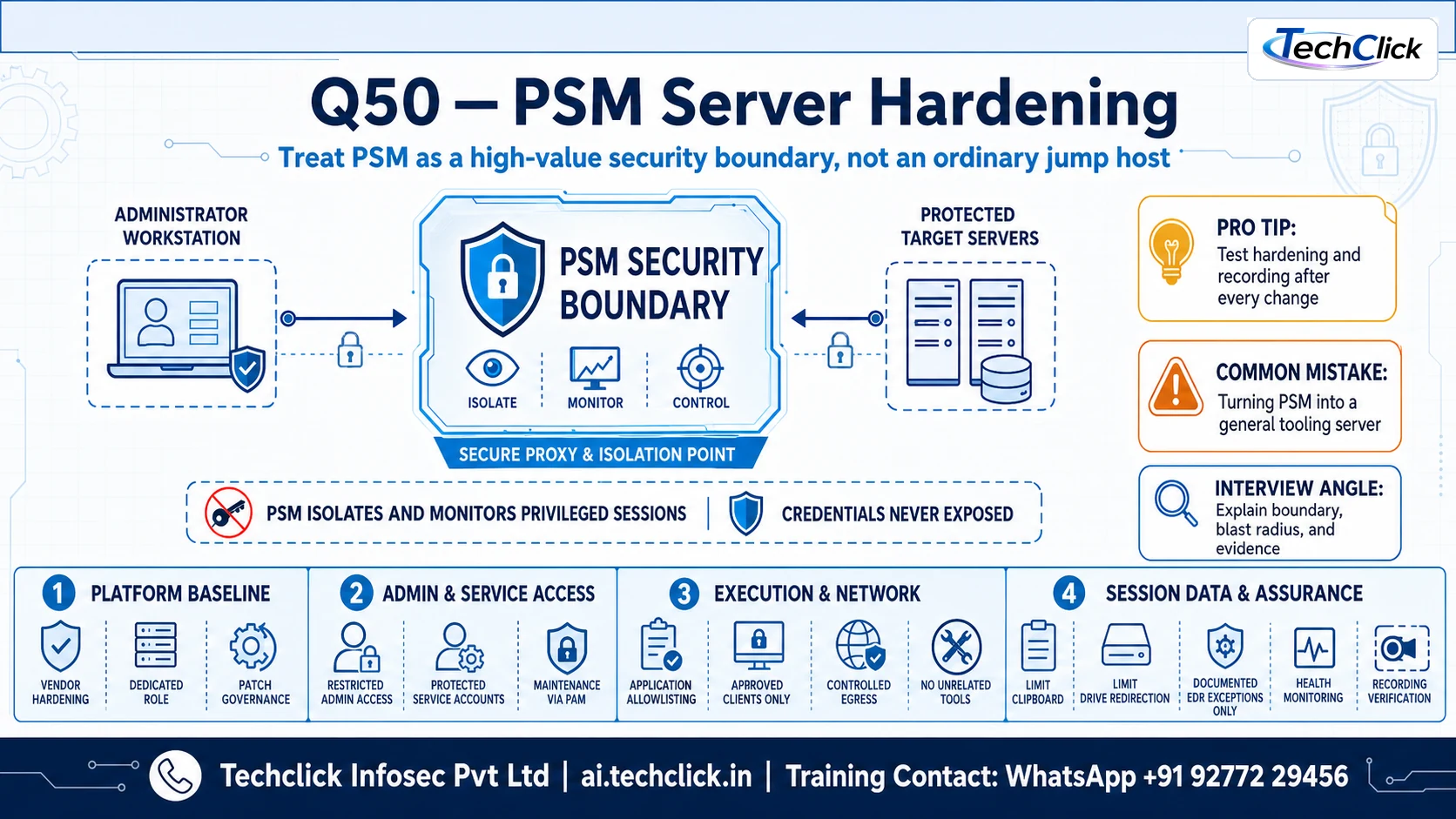
Plain explanation
PSM sits directly in the privileged session path, so a weakness on this server can affect many protected targets. Treat it as a dedicated security appliance: apply the CyberArk-supported baseline, allow only necessary administration and connection clients, minimize network and data-redirection paths, and verify the controls after every change.
Three points to remember
- Protect the platformUse vendor hardening, a dedicated role, controlled patching, and documented endpoint-protection exceptions only.
- Reduce the attack surfaceRestrict admins and service accounts, allowlist approved clients, control egress, and install no unrelated tools.
- Prove the boundaryLimit clipboard and drive redirection, monitor health, and test that session recording survives every approved change.
Explain why PSM is a high-value security boundary, not an ordinary jump host.
6. Authentication, Authorization, and Access Workflows
7 interview questions
Q51 Which authentication methods can CyberArk PAM Self-Hosted use? L2
Supported methods can include CyberArk/Vault authentication, LDAP, Windows integrated authentication, RADIUS, PKI certificates, SAML 2.0, OIDC, and FIDO-based authentication, depending on product version and interface. Additional or secondary authentication can be applied for stronger assurance.
Authentication proves the user identity; Safe membership and policy authorize account use. A successful SAML login does not automatically grant access to a Safe. Always validate version support, identity mapping, failover, clock and certificate requirements, and an emergency path before changing the primary login method.
Separate authentication from authorization and mention version-dependent support.
Q52 How does LDAP integration work? L2
The Vault is configured to recognize supported LDAP directories and mappings. Users authenticate with directory credentials, and Vault users or group relationships can be provisioned or mapped from directory attributes and group membership. The Vault still maintains CyberArk-specific authorization attributes internally.
Troubleshooting includes DNS and network reachability, TLS and certificate trust, bind or directory permissions, base DN and search filters, username format, group nesting, mapping order, duplicate identities, and Vault audit. Test with a non-emergency account and preserve a local administrative recovery method.
Explain directory authentication plus CyberArk-side authorization mapping.
Q53 How do SAML and OIDC fit into CyberArk authentication? L2
SAML or OIDC lets an external Identity Provider authenticate the user and can provide SSO and MFA. The CyberArk side trusts the IdP’s signed assertion or token, maps the subject to a user, and then applies Vault/Safe authorization. SAML 2.0 is widely used; OIDC availability depends on current product version and deployment.
Key controls include signing certificate rollover, audience and reply URL, issuer, claims or subject mapping, clock synchronization, logout behavior, permitted authentication methods, and emergency access. OIDC handles authentication; it does not by itself define Safe permissions.
Cover trust, mapping, authorization separation, certificate lifecycle, and break-glass.
Q54 How would you enforce MFA for privileged access? L2
Integrate a supported IdP, RADIUS service, PKI/FIDO method, or CyberArk identity service so high-risk users must complete strong authentication. Apply conditional controls based on user, device, risk, network, target sensitivity, or access method where supported. Require reauthentication for sensitive workflows when appropriate.
MFA protects the user login but does not replace Safe permissions, approval, PSM isolation, or target-side controls. Also design enrollment recovery, service availability, administrator lockout prevention, and monitored break-glass access.
Present MFA as one layer in a privileged-access chain.
Q55 What is the difference between Use Accounts and Retrieve Accounts? L2
Use Accounts permits a user to use a credential, commonly through a controlled connection, without necessarily displaying the password. Retrieve Accounts permits access to the secret content. Granting Use without Retrieve supports credential hiding and stronger accountability.
Effective access also depends on List Accounts, platform policy, workflow, and connection permissions. Do not grant Retrieve merely because a user needs to administer a target; prefer brokered use where the target and workflow support it.
Explain how permission design supports passwordless privileged usage.
Q56 Compare dual control, exclusive access, and one-time password behavior. L2
Dual control requires approval before access. Exclusive access prevents concurrent use by other users while an account is checked out. One-time behavior rotates the credential after the approved use or checkout period so the disclosed value cannot be reused.
They can be combined but solve different risks: approval, concurrency, and post-use credential reuse. Workflow design must also define expiry, failed check-in, emergency unlock, rotation failure, and who may bypass confirmation.
Give the risk addressed by each control in one phrase.
Q57 How should break-glass access be designed? L2
Break-glass access is a controlled emergency path for cases such as IdP, network, Vault integration, or operational failure. Use dedicated accounts with strong offline protection, narrow scope, dual custody where feasible, monitoring, documented invocation criteria, and mandatory post-use review and rotation.
Test the procedure regularly without exposing the credential. Ensure responders know whether the path depends on PVWA, Vault, PSM, Privilege Cloud, local target access, or offline-access features. A break-glass account that cannot work during the modeled outage is not a valid control.
Discuss independence from failed dependencies, governance, testing, and post-use actions.
7. High Availability, Disaster Recovery, Hardening, and Operations
8 interview questions
Q58 What does a resilient self-hosted CyberArk architecture look like? L3
A resilient design has a Primary Vault with a supported DR or distributed architecture in another failure domain, multiple PVWA and PSM nodes, appropriate CPM resilience, redundant identity and network dependencies, protected backups, and monitoring. High-traffic PVWA and PSM services are commonly deployed in pairs or pools, with target reachability considered.
Resilience must be tested as service recovery, not just server startup. Validate user authentication, account use, password management, session launch, recording, audit, and replication during planned failure exercises. Recovery objectives should define tolerated data loss and time to restore each capability.
Cover components, failure domains, dependencies, and business-service testing.
Q59 How does the DR Vault work conceptually? L3
The DR Vault is a standby replica of the Primary Vault. The CyberArk Disaster Recovery service replicates data and monitors the primary according to configuration. During an approved failover, the DR environment assumes the Vault role so dependent components can reconnect according to the design.
Monitor PADR service and PADR.log for replication health rather than assuming the standby is current. Failover and failback must follow CyberArk-supported steps, control split-brain risk, protect digital keys, and validate which writes occurred while the former primary was unavailable.
Explain standby replication, monitored health, controlled promotion, and failback risk.
Q60 What is the difference between Vault backup and DR? L3
DR provides service continuity through a replicated standby or distributed design. Backup provides a recoverable historical copy for corruption, deletion, ransomware, operator error, or disaster scenarios that replication may reproduce. One does not replace the other.
Use CyberArk-supported backup utilities and protect backup media, encryption keys, configuration, and recovery credentials. Test restore procedures in an isolated environment and define retention. A replicated bad change can reach DR quickly; a valid backup may be the only path to an earlier clean state.
Use the phrase ‘availability versus historical recoverability’.
Q61 What should be checked before Vault failover? L3
Confirm the incident and change authority, replication status and last successful sync, DR Vault service health, network and DNS or component connection behavior, key availability, potential split-brain, and the impact of writes on the old primary. Freeze unnecessary changes and preserve evidence.
After promotion, validate Vault login, PVWA access, account retrieval/use, CPM operations, PSM session launch and recording, audit, and monitoring. Plan failback based on the supported procedure and reconcile data ownership before reintroducing the former primary.
Demonstrate controlled decision-making; do not jump directly to ‘start DR service’.
Q62 How do you harden the Digital Vault? L3
Use CyberArk-supported hardening and a dedicated role, minimal software, restrictive host firewall, limited administrative access, protected digital keys, strong separation of duties, time and monitoring controls, controlled patching, and no general-purpose browsing or application workload. Vault clients commonly use the Vault protocol on default TCP 1858, but every port must be validated against the actual architecture.
Do not apply generic hardening changes that conflict with CyberArk support without testing. Protect the Master and Operator key material according to documented custody and recovery procedures, and monitor both service and security events.
Balance strict isolation with supported configuration and recoverability.
Q63 How should CyberArk upgrades be planned? L3
Start with a supported-version and compatibility matrix covering Vault, PVWA, CPM, PSM, PSM for SSH, connectors, plugins, operating systems, databases or target clients, and integrations. Review release notes and known issues, take supported backups, verify DR, test custom platforms and connectors, and define rollback.
Use a staged order from lab to non-production to production, maintain capacity while nodes are drained, and perform functional tests after each phase. Success criteria include authentication, Safe administration, CPM verify/change/reconcile, multiple session types, recordings, APIs, SIEM, and DR—not merely green Windows services.
Show compatibility, sequencing, rollback, and end-to-end validation.
Q64 Which logs and health signals should operations monitor? L3
Monitor Vault and DR service health and logs, replication status, PVWA application and session logs, CPM PM.log/PMTrace, PSM console/trace/recorder and per-session connection-component logs, PSM for SSH service and session logs, connector health, disk and recording storage, certificate expiry, API errors, and authentication integrations.
Correlate by timestamp, user, account, target, PSM/CPM node, and session ID. Alert on management failures, accounts out of compliance, recording upload failures, repeated authentication denial, Safe membership change, privileged retrieval, DR lag, and unexpected service restart.
Give both component telemetry and security-control telemetry.
Q65 What routine PAM operational reviews are important? L3
Review unmanaged or pending privileged accounts, CPM failure queues, out-of-compliance accounts, Safe ownership and membership, direct user grants, inactive or orphaned accounts, password retrievals, bypass permissions, approval quality, PSM recording completeness, connector capacity, certificates, DR replication, backup success, and break-glass readiness.
Track remediation with owners and SLA. A PAM platform can be technically available while control coverage degrades; operational metrics should therefore include percent onboarded, percent automatically managed, session-isolation coverage, recording success, mean time to remediate failures, and aged exceptions.
Focus on control effectiveness, not uptime alone.
8. Secrets, APIs, Discovery, and Privilege Cloud
10 interview questions
Q66 What is Central Credential Provider (CCP)? L2
CCP is a web-service-based credential retrieval pattern. It runs the Credential Provider on an IIS server and allows authorized remote applications or scripts to request an approved secret at runtime. The application identity and request characteristics are validated, the request is audited, and the credential remains centrally managed and rotatable.
CCP removes hard-coded secrets but introduces a highly sensitive service endpoint. Protect it with strong application authentication restrictions, least-privilege Safe access, TLS, network controls, availability, caching design, and monitoring. Do not place credentials in URL logs or application debug output.
Explain runtime retrieval, application identity, least privilege, audit, and endpoint hardening.
Q67 What is the difference between Credential Provider and CCP? L2
The local Credential Provider is installed near or on the application host and exposes supported APIs or command-line integration with a secure local cache. CCP centralizes the provider behind an IIS web service so remote applications can request secrets over an approved web interface.
The choice depends on deployment constraints, latency, platform support, network zoning, availability, and the strength of application identification. Both require the application to be defined and authorized to only the required Safe objects. Neither should become a general password-distribution service.
Compare placement, interface, cache/locality, and attack surface.
Q68 What is CyberArk Secrets Manager/Conjur used for? L2
CyberArk Secrets Manager, including Conjur-based capabilities, is designed for machine identities and dynamic application, DevOps, container, CI/CD, and cloud-native secrets. It authenticates workloads, applies policy, and delivers secrets at runtime so credentials are not embedded in code, images, or pipelines.
Integration with PAM can synchronize or source managed credentials, while the workload-facing layer provides application-native access patterns. Design around workload identity, short-lived authentication, namespace and policy ownership, rotation behavior, high availability, audit, and preventing secret leakage into environment dumps or build logs.
Differentiate human privileged sessions from machine-to-machine secret delivery.
Q69 How are CyberArk REST APIs used safely? L2
REST APIs automate authentication, Safe and member management, account onboarding, search, password operations, session or platform workflows, and reporting according to version. Use the current-generation endpoint where available, a dedicated automation identity, least-privilege permissions, secure token handling, TLS validation, bounded retries, and idempotent design.
Do not embed an administrator password in a script. Retrieve or federate the automation credential securely, avoid logging tokens or secrets, handle rate limits and partial failure, and record every change in change control. API behavior and fields differ across self-hosted and Privilege Cloud versions.
Discuss automation identity, permissions, token security, idempotency, and versioning.
Q70 How would you automate account onboarding at scale? L2
Define a validated source of truth and onboarding schema: owner, environment, target, username, platform, Safe, account type, dependency, reconcile method, PSM requirement, and risk tier. Use discovery or approved inventory feeds, deduplicate accounts, map them to governed templates, and require owner approval for ambiguous cases.
The automation should create or reuse Safes safely, assign groups, add accounts, run Verify, test rotation for eligible accounts, validate session connectivity, and report failures without exposing secrets. Use idempotent APIs and do not automatically rotate service accounts before dependency analysis.
Combine governance, data quality, automation, validation, and safe failure.
Q71 What is account discovery? L3
Discovery scans supported environments to identify privileged accounts, SSH keys, local administrators, or other candidates that are unmanaged or not yet onboarded. Results are reviewed, classified, and mapped to onboarding rules. Privilege Cloud shared services can use discovery services and connector-management agents in the customer environment.
Discovery is not proof that every result should be auto-onboarded. Validate ownership, privilege, duplicates, stale accounts, dependencies, and whether the account should be disabled, replaced with JIT access, or managed through PAM.
Explain discovery as input to a risk-governed onboarding decision.
Q72 What is a Privilege Cloud Connector or connector pool? L3
The customer-network Windows Connector houses components such as CPM and PSM so password management and privileged sessions can reach on-premises or private targets. A connector pool groups eligible connectors for availability, scale, and network locality. A UNIX connector provides PSM for SSH capability.
Operations still owns connector operating systems, reachability, capacity, hardening, and target compatibility, while the cloud backend hosts portal, Vaulting, audit, and managed services. Connector health must be monitored as part of the end-to-end service.
Separate cloud backend from customer-side execution and target access.
Q73 What is Secure Tunnel in Privilege Cloud? L3
Secure Tunnel is an optional client used for supported integrations between Privilege Cloud and customer services such as SIEM or LDAP, and for specified offline/remote-access scenarios depending on the service model. It establishes secure outbound connectivity to the cloud service.
It should not be described as the normal path through which CPM changes every target password or PSM reaches every target. Those components reside in the customer environment and connect to targets using their native management or session protocols.
State both its supported integration purpose and what it is not.
Q74 How are cloud privileged accounts managed? L3
Depending on the account type, CyberArk can manage cloud console users, application keys or secrets, service accounts, SSH keys, and privileged sessions to cloud-hosted targets. The platform and plugin must match the provider’s authentication and API model; modern cloud designs may also use JIT or ephemeral roles instead of long-lived administrator passwords.
Consider MFA restrictions, service principals, API permissions, key rotation, federation, regional endpoints, private networking, break-glass, and cloud audit logs. Do not force every cloud privilege into a password-centric pattern when native short-lived access is safer.
Show awareness of both managed static credentials and native ephemeral cloud access.
Q75 How would you secure an API or automation account used by CyberArk tooling? L3
Give it only the Safe and API permissions required, prohibit interactive use when possible, restrict source network and application identity, require short-lived tokens or secure runtime retrieval, and rotate its underlying secret. Separate read-only reporting identities from onboarding or administration identities.
Monitor authentication, API calls, Safe changes, error rates, and unusual object scope. Document ownership and emergency disablement. Automation must never print secret values or persist session tokens in build logs, shell history, or source code.
Treat automation identities as privileged machine identities with their own lifecycle.
9. Scenario-Based Interview Drills
10 production-style scenarios
Q76 CPM Verify fails, but the same password works when an administrator logs in manually. How do you troubleshoot? L3
Do not conclude that CPM is broken. Compare the exact path: CPM source server, DNS result, target port, username and domain format, platform/plugin, authentication method, logon rights, and account lockout. A manual test from another workstation may use Kerberos, cached credentials, a different DNS address, or a different protocol.
Capture the account ID, action timestamp, CPM node, and error code from PM.log. Test name resolution and connectivity from the CPM network, inspect target security logs for the attempted identity and failure reason, validate required account properties and platform, and run a controlled Verify after the cause is corrected. Enable PMTrace only if normal evidence is insufficient.
Show evidence correlation between CPM and target, not an unstructured list of restarts.
Q77 A password change failed and the account is now out of sync. What do you do? L3
Pause automatic management for the affected account to prevent repeated attempts. Determine from CPM and target logs whether the target accepted the new password and whether the Vault update completed. Check dependencies and do not guess which value is valid.
If the current managed credential cannot be established, validate the linked reconcile account and its reset authority, obtain change approval, run Reconcile during a controlled window, verify the new value, test PSM access, and validate every dependency. Record the incident and correct the platform, network, or target condition that caused the partial failure.
Recover state safely and explain why blind Change retries are dangerous.
Q78 Reconcile fails for every Windows account on one domain. What is your approach? L3
Look for shared dependencies: the reconcile account itself, its password or lockout state, domain-controller reachability, DNS, time, platform association, permissions to reset accounts, and CPM node routing. Confirm whether failures occur from all CPM nodes or one node and whether another domain works.
Inspect PM.log/PMTrace and domain-controller security logs using one test account. Validate the reconcile account through an approved test, correct the common issue, and reconcile a low-risk account before the wider queue. Avoid mass retries that can lock the reconcile identity or trigger many target changes.
Recognize a common-mode failure and limit blast radius during testing.
Q79 Users can see accounts in PVWA but all PSM sessions fail after a firewall change. L3
Account visibility proves PVWA/Vault authorization is broadly working. Focus on the broker path: user-to-PSM reachability, PSM-to-target routes and protocol ports, Vault communication, DNS, load balancer or connector-pool health, and whether the firewall change affected all PSM nodes.
Use a session ID and one representative target. Check PSM logs for whether credential retrieval and connection-component launch succeeded, then inspect firewall and target logs. Compare an unaffected network or protocol if available. Restore only the required flows; do not open broad any-any rules.
Use the last known change and isolate the exact failed network leg.
Q80 SSH through PSM for SSH fails, but direct SSH works. What should you check? L3
Verify the user’s PSMP/PSM for SSH login syntax and authentication method, Safe authorization, platform and target mapping, UNIX connector health, DNS and port reachability from the connector, supported SSH algorithms, target host-key policy, credential validity, and shell or account restrictions.
Review PSM for SSH service and session logs plus target SSH logs. Direct SSH only proves the target is reachable from the user’s machine and accepts some credential; it does not validate the connector’s route, identity, algorithm set, or CyberArk authorization.
Explain why direct success does not test the proxy path.
Q81 The Vault is unavailable during business hours. How do you respond? L3
Declare and scope the incident, preserve evidence, verify Vault service and network health, and stop unsafe changes. Confirm DR replication state and whether the problem is a server, storage, key, network, or dependency issue. Follow the approved DR decision process and prevent split-brain before promotion.
After recovery or failover, validate PVWA login, account use, CPM, PSM, recordings, audit, and monitoring. Communicate which privileged workflows are degraded and invoke only tested break-glass procedures. Plan controlled failback and root-cause remediation.
Prioritize controlled continuity and data integrity over speed-only actions.
Q82 A privileged session completed, but no recording is available. What now? L3
Treat it as a control failure. Capture session metadata and confirm whether recording was required by the effective policy. Review PSM recorder and uploader logs, disk or temporary storage, recording Safe permissions, external storage connectivity if used, size limits, and the session’s termination state.
Preserve any temporary file, correct the pipeline, run a test session, and verify retrieval as an auditor. Determine the compliance and investigation impact for the unrecorded activity and track remediation rather than marking the access ticket successful.
Separate session availability from recording-control effectiveness.
Q83 You must onboard 10,000 accounts in three months. What is your plan? L3
Create a risk-ranked inventory and data model, standardize platforms and Safe templates, define ownership and exception rules, and separate human, service, application, network, and cloud accounts. Pilot representative targets and automate idempotent onboarding through approved APIs or discovery workflows.
Use waves: discover and validate, create authorization, onboard, Verify, enable controlled rotation, validate PSM, and measure failures. Do not rotate service accounts until dependencies are known. Track coverage, management success, isolation, recording, aged exceptions, and owner acceptance. Scale CPM/PSM and support capacity with the onboarding volume.
Combine program governance, technical automation, risk waves, and measurable acceptance.
Q84 How would you provide a vendor temporary access to a critical server? L3
Use a named vendor identity with strong MFA and verified sponsorship, a time-bounded request, explicit target scope, approval, and no password disclosure. Broker access through PSM or an approved remote-access integration, restrict clipboard/file transfer and permitted connection components, record the session, and monitor high-risk activity.
Expire the identity and entitlement automatically, rotate any standing target credential after use if exposed, review the recording, and retain evidence. Avoid shared vendor accounts and permanent VPN-plus-admin access.
Design identity assurance, time-bound authorization, isolation, monitoring, and clean revocation.
Q85 How would you explain your CyberArk implementation experience in an interview? L3
Use a structured story: environment and risk, your exact responsibility, architecture, onboarding volume and account types, Safe and platform design, identity integrations, CPM and PSM workflows, HA/DR, automation, major troubleshooting example, and measurable outcome. Be precise about what you personally configured versus what the team owned.
Example framework: ‘We protected Windows, UNIX, database, network, and service accounts across two data centers. I owned platform testing, Safe templates, onboarding automation, CPM failure operations, and PSM troubleshooting. We moved administrators to brokered sessions, raised automatic-management coverage, reduced aged failures, and tested DR quarterly.’ Use real numbers only if you can defend them.
Evidence, ownership, scale, difficult incident, and outcome are stronger than a list of component names.
Rapid Revision Sheet
| Term | Interview-ready meaning |
|---|---|
| Vault | Protected credential, audit, and policy store; default Vault protocol commonly TCP 1858. |
| PVWA | Web portal and REST/API entry point; authorizes workflows and launches PSM connections. |
| CPM | Verify = test; Change = rotate with current credential; Reconcile = recover with a reset-capable account. |
| PSM | Broker, isolate, hide credentials, monitor, record, and audit the target session. |
| PSM for SSH | Native SSH proxy for UNIX/Linux/network targets; terminal-oriented recordings. |
| Safe | Logical authorization boundary holding account objects; govern membership with least privilege. |
| Platform | Account-type management and connection template, including target-specific plugin behavior. |
| Master Policy | Enterprise baseline; use documented platform exceptions only where justified. |
| Dual control | Approval before use. |
| Exclusive access | Only one user or request can use the account at a time. |
| Privilege Cloud | Cloud-managed backend with customer-side connectors for CPM/PSM target operations. |
| Troubleshooting | Identity → portal → authorization/Vault → broker or manager → target; test every hop separately. |
Ten answers you must give without notes
- Self-hosted component roles and the full PSM session flow.
- Verify vs Change vs Reconcile, including failure recovery.
- Safe vs platform vs account object and least-privilege permissions.
- Dual control vs exclusive access vs one-time behavior.
- CPM failure investigation using PM.log, target evidence, and controlled tracing.
- PSM failure isolation across authentication, authorization, broker, and target legs.
- Privilege Cloud backend versus customer connector responsibilities.
- DR versus backup and a controlled Vault failover approach.
- Service-account dependency onboarding and rollback.
- A real project story with your responsibility, scale, incident, and measurable result.
Official References and Version Notes
Version note: CyberArk product names, interfaces, supported operating systems, APIs, and authentication methods change by release and service model. This guide uses official documentation available on 20 July 2026 and marks environment-dependent behavior.
- PAM Self-Hosted architecture
- Privilege Cloud architecture
- PSM architecture
- Install PSM — installation and hardening stages
- CyberArk session management security and PSM host-hardening guidance
- PSM for SSH introduction
- Master Policy framework
- Automatic account management
- Dual control
- Account check-out and check-in
- Authentication methods
- CyberArk REST API — Safe members
- Credential Providers / CCP
- Self-Hosted design and resilience guidance
- CPM logs
- PVWA logging
- PSM administration and logs