Start here · learn the idea before the technical detail
What you are learning
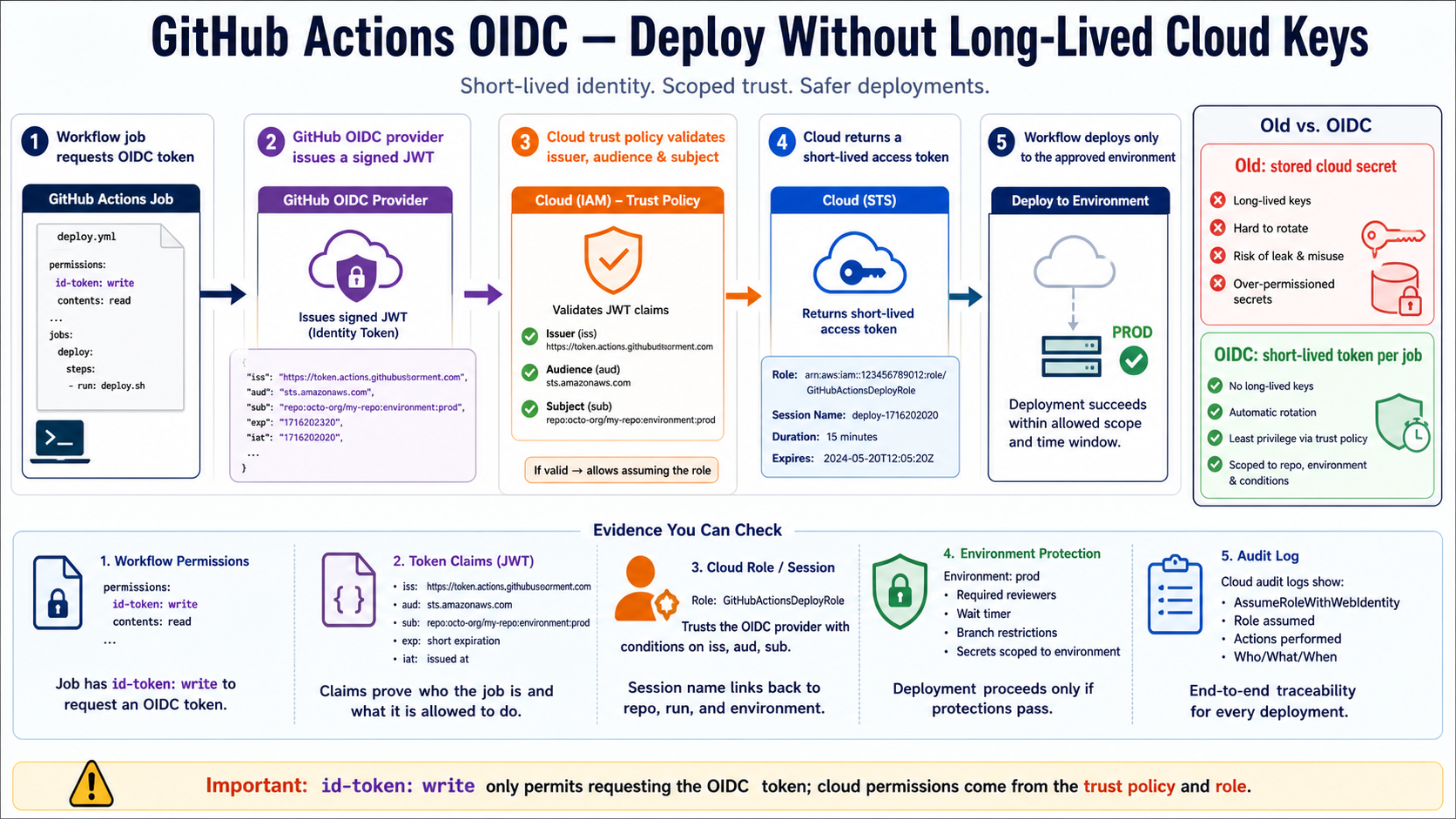
This lesson explains how a GitHub Actions workflow can reach a cloud platform without storing a long-lived cloud key. The important idea is trust: the cloud accepts a short-lived GitHub identity only when its claims match rules you configured.
In plain English
OIDC lets a workflow ask GitHub for a signed identity token. The cloud checks who issued it and whether its repository, branch, environment, or other claims match the trust policy. If they match, the cloud returns temporary credentials.
Real example
A deployment job from the approved main branch requests an OIDC token. The cloud role trusts only that repository and branch. A pull request from an untrusted fork has different claims, so the role assumption fails and no cloud credential is issued.
Follow this flow
- Configure GitHub as an identity provider in the cloud platform.
- Create a narrowly scoped cloud role and restrict its trust conditions.
- Give the workflow id-token: write and only the permissions it needs.
- Request the signed OIDC token during the job.
- Let the cloud validate the claims and issue short-lived credentials.
- Deploy, then review both workflow and cloud audit logs.
Evidence to collect
- Workflow file and job permissions
- Token issuer, audience, subject, and repository claims
- Cloud trust-policy conditions
- Temporary role/session identity
- Workflow run and cloud audit event
Common mistake to avoid
Do not treat id-token: write as permission to modify cloud resources. It only allows the workflow to request an OIDC token. The temporary cloud role determines what the job can actually do.
Current official source checkpoint
- GitHub OIDC in cloud providersofficial reference checked for this explanation
- GitHub OIDC referenceofficial reference checked for this explanation
Key terms before you continue
Most engineers think...
Most candidates describe CI/CD OIDC workload identity federation as a product name and stop there. That is not enough for L2/L3 work.
The better model is operational: know the components, follow the flow, prove the policy hit, and explain the failure path. For this topic, the core idea is OIDC token and Trust policy.
① What it solves and where it sits
OIDC federation lets CI/CD jobs request short-lived cloud credentials instead of storing long-lived cloud keys in repository secrets. The control point becomes claim design, audience, branch/environment policy and cloud trust mapping.
Production use case: Use it when DevSecOps teams want GitHub Actions, GitLab, Azure DevOps or other pipelines to deploy without static credentials.
Best one-line description of CI/CD OIDC workload identity federation?
② Core components you must name
Use these names before jumping to troubleshooting. They anchor the architecture and make the interview answer sound practical.
- OIDC token — Short-lived identity assertion issued by the CI/CD platform
- Trust policy — Cloud-side rule that accepts only expected issuer, audience and subject claims
- Environment gate — Branch, tag, reviewer or environment condition that limits credential issuance
- Cloud role — Temporary permission set assumed by the pipeline job
- Audit log — Evidence of token request, role assumption and deployed resource changes
Say the path in order: Workflow starts → OIDC token issued → Trust policy checks → Cloud role assumed → Audit deploy. It keeps the answer structured.
A decision is not real until logs/events show the rule, object and final action.
Most outages are not product magic; they are forwarding, health, identity, certificate or rule-order problems.
Safe rollout: Pilot discovery in monitor mode, validate owners and evidence, then enforce on a small ring before broad rollout..
Lead with OIDC token, Trust policy, Environment gate. It sounds like production work, not brochure reading.
Which item belongs in the core architecture?
③ The traffic or telemetry path
The healthy path is: Workflow starts → OIDC token issued → Trust policy checks → Cloud role assumed → Audit deploy. Walk it left to right. If a user report says 'it is broken', locate the exact stage where evidence stops.
The primary control is: Use OIDC token and Trust policy to make a scoped security decision and prove it with logs or policy evidence..
If Workflow starts never reaches the control point, no later policy can help. Confirm steering/forwarding first.
▶ Watch the CI/CD OIDC workload identity federation decision path
Press Play for the healthy path, then Break it for the common outage.
What should you trace first during troubleshooting?
④ Operations, rollout and interview response
The safe rollout answer is: Pilot discovery in monitor mode, validate owners and evidence, then enforce on a small ring before broad rollout.. That prevents broad production impact while still moving toward enforcement.
Compared with repository-stored cloud access keys, the value is richer policy context, better visibility and a clearer operational evidence trail.
Rohan at a Noida SOC gets this ticket
A pull request workflow unexpectedly receives production deployment permissions.
The trust policy accepts a broad subject claim or lacks branch/environment restrictions, so untrusted workflow contexts can assume the role.
Trace Workflow starts → OIDC token issued → Trust policy checks → Cloud role assumed → Audit deploy, then compare policy logs, object health and user scope.
Console ▸ policy/logs ▸ health/status ▸ affected user testReview issuer, audience, subject claim, environment protection, cloud role scope and audit logs; then narrow the trust policy and retest a denied PR path.
Repeat the original user test and capture the allow/block/health evidence in logs.
The final answer should include log evidence, health state and a user test. That is what separates RCA from guessing.
Safest production rollout answer?
🤖 Ask the AI Tutor
Tap any question — instant, scoped to this lesson. No login, no waiting.
Pre-curated from vendor docs + community Q&A, scoped to this lesson. For a live prod issue, paste your export into chat.techclick.in.
📝 Wrap-up assessment — six more
You've answered 4 inline. Six left. 70% (7 of 10) marks the lesson complete on your profile. Tap Submit all answers at the end.
🧠 In your own words
Explain CI/CD OIDC workload identity federation in one L2 interview sentence.
🗣 Teach a friend
Best way to lock it in — explain it in one line to a teammate. Tap to generate a paste-ready summary.
📖 Glossary
- OIDC token
- Short-lived identity assertion issued by the CI/CD platform
- Trust policy
- Cloud-side rule that accepts only expected issuer, audience and subject claims
- Environment gate
- Branch, tag, reviewer or environment condition that limits credential issuance
- Cloud role
- Temporary permission set assumed by the pipeline job
- Audit log
- Evidence of token request, role assumption and deployed resource changes
- Evidence trail
- Logs, policy state, ownership, health and retest data used to prove the decision.
📚 Sources
What's next?
Next, pair this lesson with the new CI/CD OIDC workload identity federation interview Q&A page and explain the same flow out loud in 90 seconds.