TTechclick ⚡ XP 0% All lessons
Akamai · Bot ManagerInteractive · L1 / L2 / L3

Akamai Bot Manager Credential Stuffing Runbook - Endpoint-Specific Bot Scores and Actions

Login, checkout and account endpoints need different bot decisions. This lesson explains Akamai Bot Manager score-based controls, challenge choices, throttling, false positives and API/native-app traps.

📅 2026-06-27 · ⏱ 17 min · 5 infographics · scenario lab · 🏷 10-Q assessment + AI Tutor inline

⚡ Quick Answer

Akamai Bot Manager uses endpoint-aware bot evidence and score-based actions such as allow, challenge, throttle, alternate response or block. Good tuning changes by endpoint and user journey.

🎯 By the end you will be able to

Read as:

Pick where you want to start

1

What it solves

Use it during credential stuffing, scraping, fake account creation and checkout abuse investigations.

2

Core objects

Name the pieces before you troubleshoot.

3

Traffic path

Follow one request through the decision chain.

4

Ops & interview

Failure, evidence, fix and verification.

🧠 Warm-up — 3 questions, no score

Just notice which ones make you pause. We answer all three inside the lesson.

1. What is the fastest way to avoid vague Akamai answers?

Answered in Traffic path.

2. What proves a policy decision in production?

Answered in Ops & interview.

3. What is the safest rollout pattern?

Answered in Ops & interview.

Most engineers think...

Most candidates describe Akamai Bot Manager Credential Stuffing Runbook as a product name and stop there. That is not enough for L2/L3 work.

The better model is operational: know the components, follow the flow, prove the policy hit, and explain the failure path. For this topic, the core idea is Bot score, endpoint policy and mitigation action.
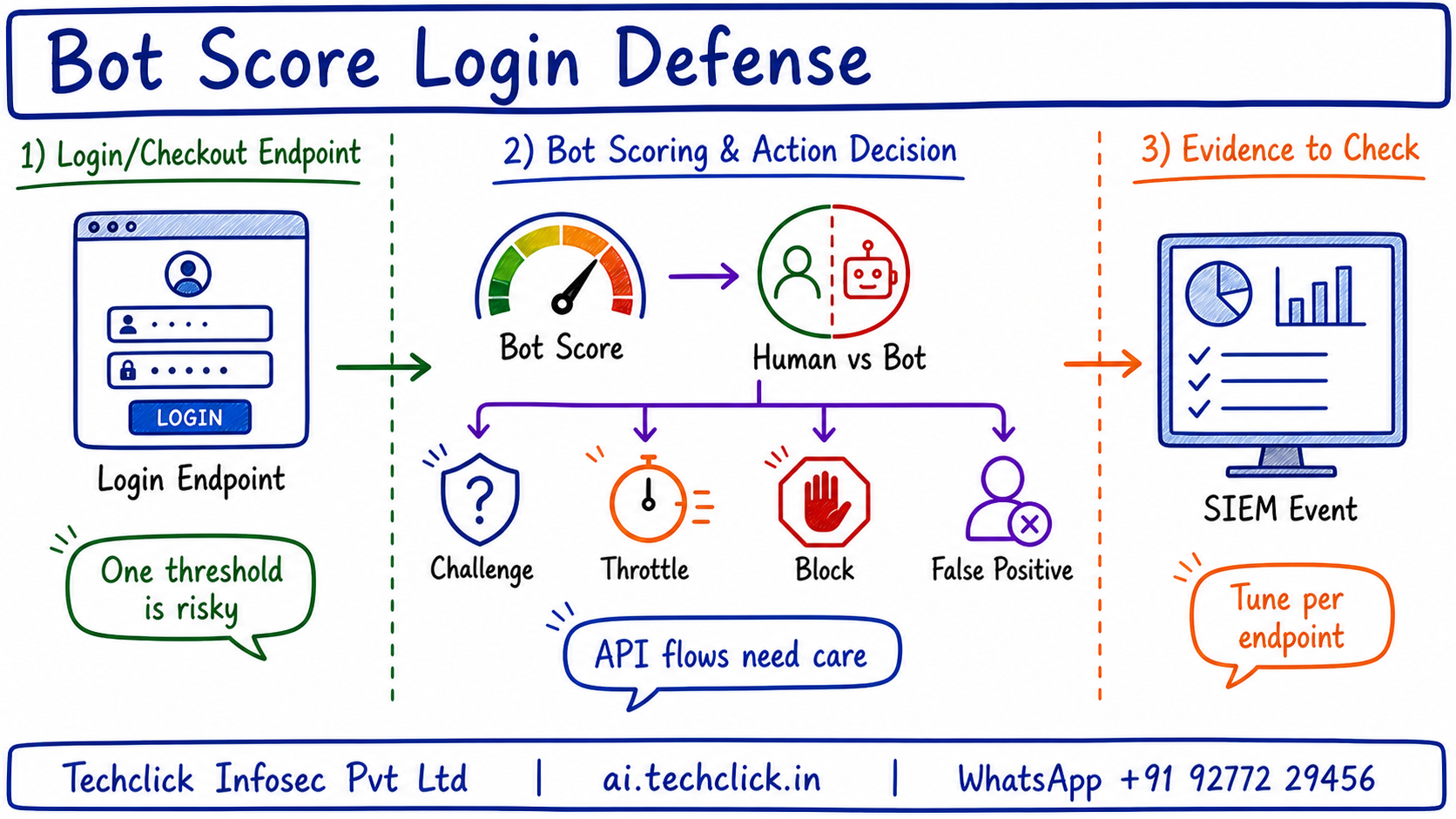
ChatGPT Image infographic - Akamai Bot Manager Credential Stuffing Runbook
Handwritten Techclick infographic explaining Akamai Bot Manager Credential Stuffing Runbook architecture, flow and evidence points.
Use this visual first: it summarizes the Akamai Bot Manager Credential Stuffing Runbook flow, control points and evidence checklist before the deeper lesson.

① What it solves and where it sits

Bot controls fail when one threshold is applied everywhere. Login, checkout, search and API paths have different user behavior and different false-positive cost.

Production use case: Use it during credential stuffing, scraping, fake account creation and checkout abuse investigations.

Figure 1 — Akamai Bot Manager Credential Stuffing Runbook healthy flow
Start with this path when explaining or troubleshooting.Akamai Bot Manager Credential Stuffing Runbook healthy flowDetect sessiondecision pointScore botdecision pointMatch endpointdecision pointChoose actiondecision pointReview resultdecision point
Start with this path when explaining or troubleshooting.
Quick check · Q1 of 10 · Understand

Best one-line description of Akamai Bot Manager Credential Stuffing Runbook?

Correct: b. The core is Bot score, endpoint policy and mitigation action; explain the architecture and evidence path, not only the product name.
👉 So far: Akamai Bot Manager Credential Stuffing Runbook solves Use it during credential stuffing, scraping, fake account creation and checkout abuse investigations..

② Core components you must name

Use these names before jumping to troubleshooting. They anchor the architecture and make the interview answer sound practical.

Figure 2 — Component stack
The named objects/components that carry the design.Component stackBot scoreRates likely human versus automation behaviorEndpoint policyApplies different actions to login, checkout and API pathsChallenge actionVerifies suspicious sessions without hard blocking every userThrottle/alternateReduces abusive automation while preserving serviceFalse-positive reviewProtects real customers and mobile/API flows
The named objects/components that carry the design.
🧭
Flow first
tap to flip

Say the path in order: Detect session → Score bot → Match endpoint → Choose action → Review result. It keeps the answer structured.

🛡
Policy proof
tap to flip

A decision is not real until logs/events show the rule, object and final action.

🔧
Health gate
tap to flip

Most outages are not product magic; they are forwarding, health, identity, certificate or rule-order problems.

📊
Rollout
tap to flip

Safe rollout: Start with observe or low-friction actions, segment endpoint thresholds, test API/native clients, then harden high-confidence automation.

Name objects before tools

Lead with Bot score, Endpoint policy, Challenge action. It sounds like production work, not brochure reading.

Quick check · Q2 of 10 · Remember

Which item belongs in the core architecture?

Correct: c. Bot score is one of the named components you should use in a precise answer.
👉 So far: Core components: Bot score, Endpoint policy, Challenge action, Throttle/alternate.

③ The traffic or telemetry path

The healthy path is: Detect session → Score bot → Match endpoint → Choose action → Review result. Walk it left to right. If a user report says 'it is broken', locate the exact stage where evidence stops.

The primary control is: Validate bot score, endpoint, category, action, challenge result, telemetry and false-positive sample.

Figure 3 — Policy and evidence hub
Good troubleshooting ties every path back to policy, health and logs.Policy and evidence hubPolicy + logstruth sourceBot scoreEndpoint policyChallenge actionThrottle/alternateFalse-positive review
Good troubleshooting ties every path back to policy, health and logs.
Figure 4 — Healthy versus broken path
The right side is the classic failure you should catch quickly.Healthy versus broken pathHealthyTraffic is steered correctlyPolicy/object health is validLogs show final actionUser impact is scopedBrokenThe same bot threshold orEvidence stops earlyUsers see inconsistent resultsFix needs verification
The right side is the classic failure you should catch quickly.
Do not skip the first hop

If Detect session never reaches the control point, no later policy can help. Confirm steering/forwarding first.

▶ Watch the Akamai Bot Manager Credential Stuffing Runbook decision path

Press Play for the healthy path, then Break it for the common outage.

① Detect sessionDetect session: Akamai Bot Manager Credential Stuffing Runbook advances this stage and records evidence for troubleshooting.
② Score botScore bot: Akamai Bot Manager Credential Stuffing Runbook advances this stage and records evidence for troubleshooting.
③ Match endpointMatch endpoint: Akamai Bot Manager Credential Stuffing Runbook advances this stage and records evidence for troubleshooting.
④ Choose actionChoose action: Akamai Bot Manager Credential Stuffing Runbook advances this stage and records evidence for troubleshooting.
Press Play to step through the healthy path. Then press Break it.
Quick check · Q3 of 10 · Apply

What should you trace first during troubleshooting?

Correct: a. Start at Detect session and follow the flow until evidence stops.
👉 So far: Healthy flow: Detect session → Score bot → Match endpoint → Choose action → Review result.

④ Operations, rollout and interview response

The safe rollout answer is: Start with observe or low-friction actions, segment endpoint thresholds, test API/native clients, then harden high-confidence automation. That prevents broad production impact while still moving toward enforcement.

Compared with IP/user-agent blocking only, the value is richer policy context, better visibility and a clearer operational evidence trail.

Figure 5 — Interview troubleshooting path
Use this sequence to avoid random guessing.Interview troubleshooting pathConfirmscope + symptomTraceflow stageCheckpolicy + healthFixsmall changeVerifylogs + user test
Use this sequence to avoid random guessing.

Rohan at a Noida SOC gets this ticket

Credential stuffing drops after bot controls, but mobile-app login errors spike.

Likely cause

The same bot threshold or challenge was applied to native/API login flows without client-specific testing.

Diagnosis

Trace Detect session → Score bot → Match endpoint → Choose action → Review result, then compare policy logs, object health and user scope.

Console ▸ policy/logs ▸ health/status ▸ affected user test
Fix

Separate endpoint policies, review score/action/challenge results, lower friction for real app clients and keep hard blocks for confirmed automation.

Verify

Repeat the original user test and capture the allow/block/health evidence in logs.

Close with proof

The final answer should include log evidence, health state and a user test. That is what separates RCA from guessing.

Quick check · Q4 of 10 · Evaluate

Safest production rollout answer?

Correct: d. A controlled pilot with monitoring and verification reduces blast radius while building confidence.
👉 So far: Classic failure: The same bot threshold or challenge was applied to native/API login flows without client-specific testing.

🤖 Ask the AI Tutor

Tap any question — instant, scoped to this lesson. No login, no waiting.

Pre-curated from vendor docs + community Q&A, scoped to this lesson. For a live prod issue, paste your export into chat.techclick.in.

📝 Wrap-up assessment — six more

You've answered 4 inline. Six left. 70% (7 of 10) marks the lesson complete on your profile. Tap Submit all answers at the end.

Q5 · Remember

What should you name before troubleshooting?

Correct: b. Naming objects and flow prevents random guessing.
Q6 · Understand

What proves a policy decision?

Correct: a. Logs/events prove rule match, action, object and user context.
Q7 · Apply

Where should you start tracing Akamai Bot Manager Credential Stuffing Runbook?

Correct: c. Start at Detect session and move stage by stage.
Q8 · Analyze

Why is a pilot safer than global enforcement?

Correct: b. Pilot scope lets you catch false positives or broken forwarding before broad impact.
Q9 · Evaluate

Best interview closing line?

Correct: d. Verification is the only defensible close to a production troubleshooting answer.
Q10 · Evaluate

What is the likely root cause in this lesson's scenario: Credential stuffing drops after bot controls, but mobile-app login errors spike.

Correct: c. The same bot threshold or challenge was applied to native/API login flows without client-specific testing.
Lesson complete — saved to your profile.
Almost! You need 70% (7 of 10) — re-read the path that tripped you up and tap "Try again".

🧠 In your own words

Explain Akamai Bot Manager Credential Stuffing Runbook in one L2 interview sentence.

Expert version: Akamai Bot Manager Credential Stuffing Runbook should be explained by the flow Detect session → Score bot → Match endpoint → Choose action → Review result, the core control Bot score, endpoint policy and mitigation action, and the proof points: policy logs, health state and user verification.

🗣 Teach a friend

Best way to lock it in — explain it in one line to a teammate. Tap to generate a paste-ready summary.

📖 Glossary

Security policy
The Akamai policy object that decides alert, deny, exception and control behavior.
ASE
Adaptive Security Engine, the request-risk analysis layer used by Akamai WAAP controls.
Bot score
A value used by bot controls to distinguish likely automation from likely human sessions.
DataStream
Akamai streaming log export path used for SIEM and data-lake evidence.
GRE
Generic Routing Encapsulation tunnel used in many routed DDoS clean-traffic designs.
Label
Guardicore segmentation metadata used to group workloads and build policy.

📚 Sources

  1. Akamai Bot Manager
  2. Akamai App & API Protector
  3. Akamai API Security
  4. Akamai Prolexic DDoS Protection
  5. Akamai Client-Side Protection & Compliance

What's next?

Next, pair this lesson with the new Akamai Bot Manager Credential Stuffing Runbook interview Q&A page and explain the same flow out loud in 90 seconds.