1. Why the old WAN broke
Ticket: Pune branch cannot reach SAP in Mumbai. Internet and MPLS both ping. No IPsec overlay. Manager shows the router as not connected.
Classic WAN backhauled SaaS and internet through the data center. Bandwidth was expensive, change windows were long, and a backup circuit sat idle. SD-WAN keeps the same underlay circuits and adds a software overlay that can use every transport in active/active mode.
Cisco bought Viptela. The product is now Cisco Catalyst SD-WAN. Interviews still say Viptela. Draw both names, then forget the argument.
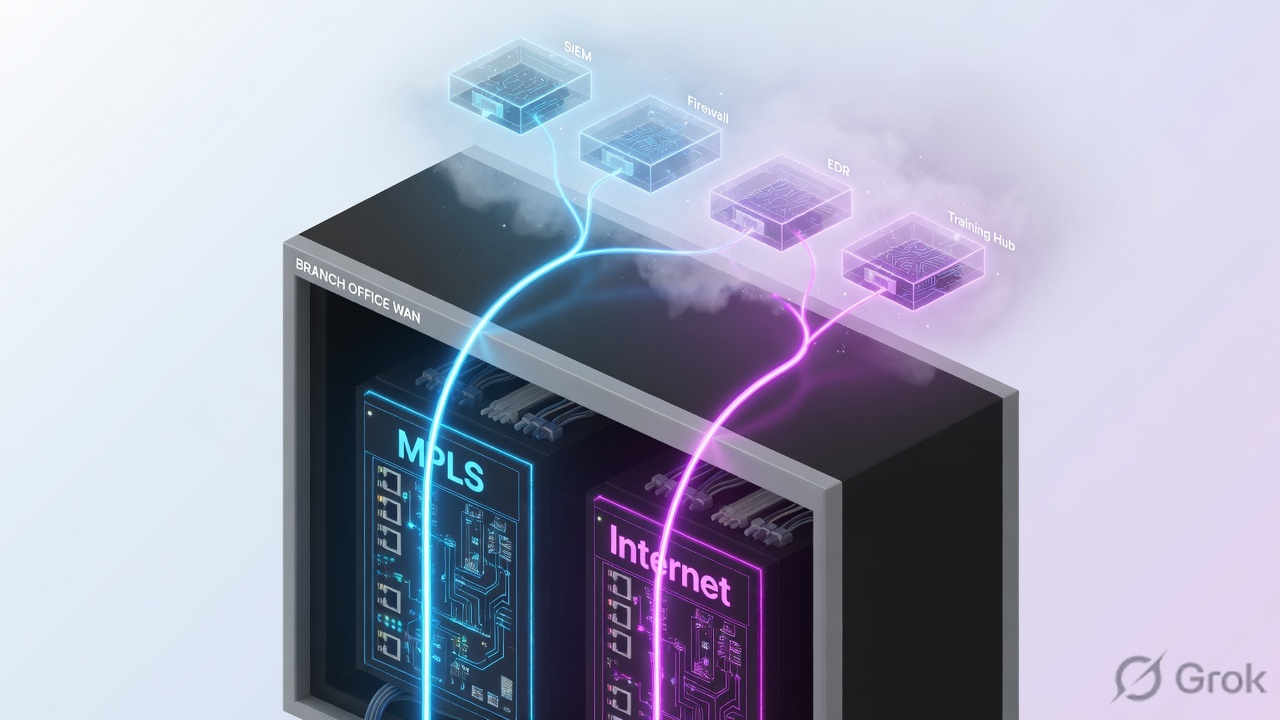
vBond (Validator) introduces the Edge. vManage (Manager) configures and monitors it. vSmart (Controller) reflects OMP routes, TLOCs, and policy. The WAN Edge encrypts and forwards. Control is DTLS/TLS. Data is IPsec plus BFD.
2. Four planes — old name and new name
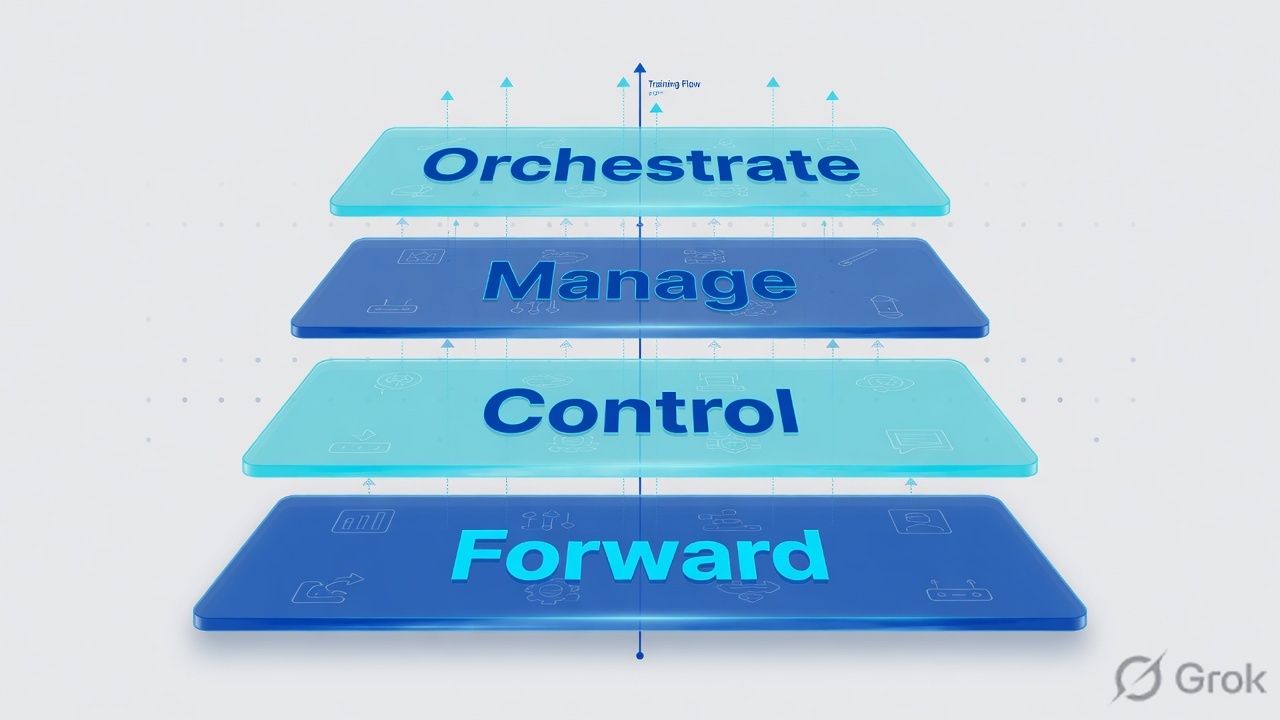
Cisco rebranded the controllers. The planes did not change. If you only remember one table from this lesson, remember this one.
| Plane | Old Viptela name | Catalyst name | What it actually does |
|---|---|---|---|
| Orchestration | vBond | SD-WAN Validator | First authentication. Hands out Manager and Controller reachability. Helps NAT discovery. Always DTLS. |
| Management | vManage | SD-WAN Manager | GUI and API. Templates, certificates, monitoring, Day 0–2. One permanent control connection from each Edge, over one transport. |
| Control | vSmart | SD-WAN Controller | OMP route reflector. Distributes prefixes, TLOCs, keys, and centralized policy. Never forwards user packets. |
| Data | vEdge / cEdge | WAN Edge | IPsec/GRE tunnels, BFD, QoS, BGP/OSPF on the service side, security features on IOS XE. |
Together, Manager + Controller + Validator are the control components. The Edge is not a controller.
Read left to right. Validator introduces. Manager owns config. Controller owns topology. Edge forwards.
Validator is the airport information desk. Manager is the operations office. Controller is air-traffic control. The Edge is the aircraft. Planes do not swap jobs.
VPN 0
Transport VPN. WAN interfaces and DTLS/TLS live here. Needs a default or static so the Edge can reach the Validator.
VPN 512
Out-of-band management. OMP ignores it. It is not carried across the overlay.
Service VPNs
User LAN. Recommended 1–511. On IOS XE these become numbered VRFs. Do not put LAN in VPN 0.
vEdge vs cEdge
vEdge = Viptela OS (EOS/EOL: 20.6 last for 100/1000, 20.9 last for 2000/5000/Cloud). New designs use IOS XE WAN Edge (cEdge).
3. Bring-up flow
Controllers come up first. Manager and Controller form persistent DTLS to every Validator, then a permanent DTLS or TLS session to each other. Only after that does an Edge have someone to join.
The Edge never stays married to the Validator in a healthy overlay. Validator is the introduction. Manager and Controller are the marriage.
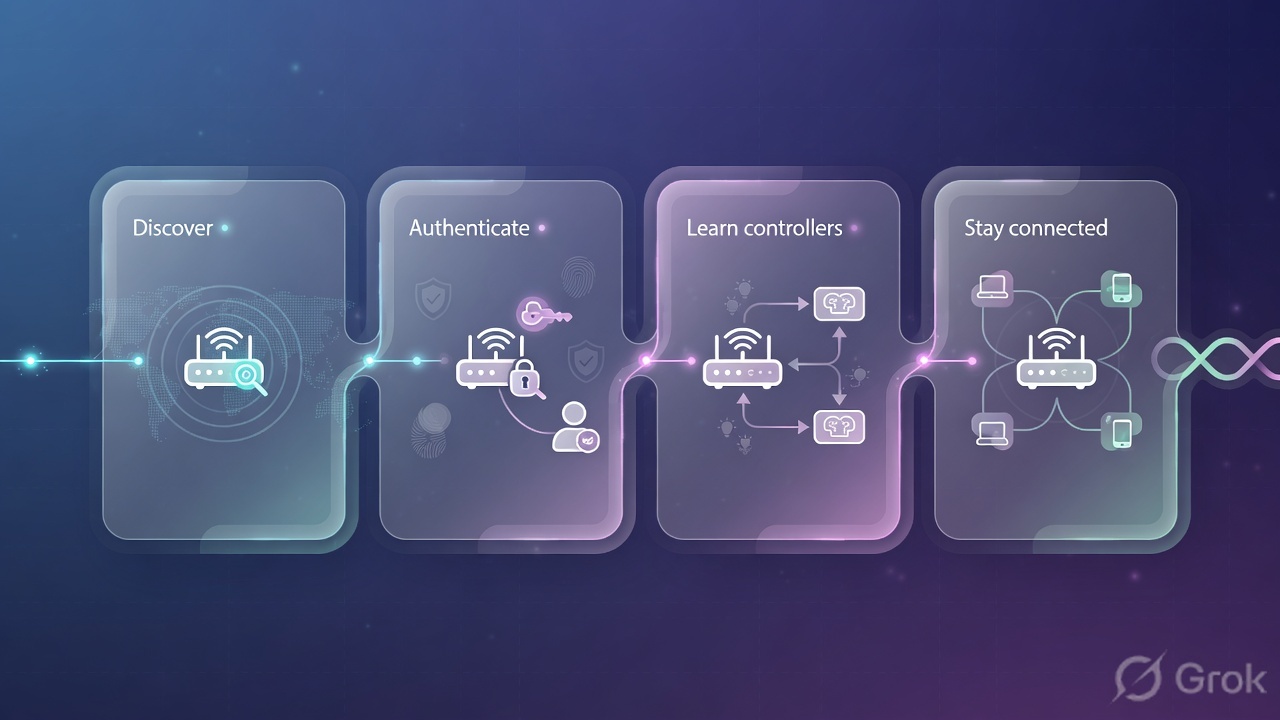
Source: Cisco Catalyst SD-WAN Design Guide — WAN Edge control connections.
DTLS / TLS — control channel. Validator is always DTLS. Manager and Controller default to DTLS; TLS (TCP) can be configured and wins if one side asks for it.
OMP — Overlay Management Protocol. BGP-like. Carries prefixes, TLOCs, keys, and policy. One session per Controller, keyed by system-IP.
TLOC — Transport Locator. Three-tuple: system-IP + color + encapsulation. Color cannot repeat on one Edge.
BFD — runs on every data-plane tunnel. Measures loss, latency, jitter. Control up + BFD down is a data-plane ticket, not a bring-up ticket.
4. How to choose the onboard method
All three methods end at the same Validator. They differ in how the Edge learns that Validator’s address.
| Method | Use when | First contact | Do not mix |
|---|---|---|---|
| Manual / CLI bootstrap | Lab, brownfield, or no cloud reachability | You type vbond, org, site-id, system-ip, VPN 0 tunnel | Leaving organization-name different from controllers |
| ZTP | vEdge / Viptela OS factory default | Resolves ztp.viptela.com, then is pointed at your Validator | Using this URL on IOS XE |
| PnP | IOS XE WAN Edge (cEdge) | Resolves devicehelper.cisco.com via Cisco Plug and Play Connect | Using the vEdge ZTP hostname |
Authorized serial list states, from the Design Guide:
- Valid — full member. Control + OMP + data.
- Invalid — no control connections.
- Staging — control forms, but OMP sends no routes, no data policy, no TLOCs. Traffic does not forward. Use this to test a box before production.
5. Runbook — Side A / B / C
Lab values on this page are dummy: org Techclick-Lab, site-id 100, system-ip 10.1.10.1, Validator 203.0.113.10 / vbond.lab.example.com. Confirm live syntax on your release before you type on a real box.
Side A — Edge (IOS XE / cEdge)
Source: Cisco TAC 214509 — system block, VPN 0 tunnel, certificate, clock.
-
Confirm identity and clock
Wrong clock breaks cert validation (
CRTVERFL). Organization name is case-sensitive and must match every controller.cEdge · dummy labshow clock show sdwan control local-properties | include organization-name|site-id|system-ip|certificate|dns-name|chassis-num|serial-num
-
System block must exist
Required fields (concept — verify syntax on your IOS XE train)system system-ip 10.1.10.1 site-id 100 organization-name Techclick-Lab vbond vbond.lab.example.com
-
VPN 0 transport with tunnel
No tunnel option on the WAN interface = no control. Need a route in VPN 0 toward the Validator.
-
Reach Validator, then watch history
Proof commandsping vrf 0 203.0.113.10 show sdwan control connections show sdwan control connections-history show sdwan control local-properties
On vEdge the command is show control connections. On IOS XE insert sdwan: show sdwan control connections. Same output idea. Wrong keyword looks like the feature is missing.
Side B — Manager (certificates and list)
Source: Design Guide authorized-list model + TAC 214509 Configuration → Certificates → Send to Controllers.
Configuration → Certificates → WAN Edge list
WAN Edge authorized serials
| Chassis / unique-id | Serial | State | Hostname |
|---|---|---|---|
| C8000V-9AB12C | 016E9A10 | Valid | pune-br1 |
| C8000V-9AB12D | 016E9A11 | Staging | lab-spare |
| ISR4331-FGL0001 | 016E9A12 | Invalid | — |
List lives on Manager, then must be pushed. Send to Controllers or the Validator still rejects the chassis (BIDNTVRFD).
-
Get the serial onto the overlay
Plug and Play Connect at
software.cisco.com(signed list) or a CSV from 20.3.1 onward. Sync or upload into Manager. -
Set Valid (or Staging first)
If you imported without “validate devices”, everything starts Invalid. Invalid = no control. Staging = control only, no OMP payload.
-
Send to Controllers
Until this push, Validator does not trust the chassis. Confirm later with
show orchestrator valid-vedgeson the Validator. -
Attach a device template
Missing template shows
NOVMCFGtoward Manager. Control may still reach Validator/Controller while Manager tears down.
Configuration → Devices → WAN Edge
pune-br1 · site 100
| Peer | Color | Protocol | State |
|---|---|---|---|
| Manager 10.0.1.1 | biz-internet | dtls | up |
| Controller 10.0.1.5 | biz-internet | dtls | up |
| Controller 10.0.1.5 | mpls | dtls | up |
| Validator | — | dtls | transient / gone |
Healthy Edge: Manager on one color, Controller on each color, Validator not sitting there forever.
Side C — Sync / prove
Source: Design Guide control-connection summary + TAC 214509 history codes.
-
Control table is green
Expectshow sdwan control connections ! peer-type vmanage — one row, state up ! peer-type vsmart — one row per transport (often two) ! peer-type vbond — absent, or only if out of equilibrium
-
OMP and TLOCs
Nextshow sdwan omp peers show sdwan omp tlocs advertised show sdwan bfd sessions
-
If history is ugly, decode the code
Do not rebuild IPsec first. Read LOCAL ERROR on
show sdwan control connections-history.
6. After join — control vs data
Bring-up success is control-plane success. Users still fail if BFD never comes up. Separate the two tickets.
User packets never hairpin through vSmart. Controller only reflects. Edge-to-Edge is the data plane.
Validator listens on UDP 12346. Manager and Controller cores use 12346, then 12446, 12546… TLS uses TCP (commonly 23456 on the controller side). If large UDP is dropped, you get DCONFAIL even when ping works.
7. Traps and proof

| Symptom / code | First meaning | First fix |
|---|---|---|
DCONFAIL | DTLS never completes. Firewall, no default in VPN 0, DTLS port closed, large UDP dropped. | Ping next hop and Validator. Open UDP 12346. Capture if small packets pass and large ones die. |
CTORGNMMIS | Organization name does not match. | Compare organization-name on Edge vs controllers. Case matters. |
BIDNTVRFD / CRTREJSER | Chassis or serial not on the authorized list, or list not pushed. | PnP/CSV → Manager → Valid → Send to Controllers. Check show orchestrator valid-vedges. |
CRTVERFL | Certificate cannot be validated. | Fix clock. Reinstall root chain. Confirm cert validity window. |
NOVMCFG | No device template in Manager. | Attach a template. Do not chase IPsec. |
DISTLOC | TLOC disabled after a color, system-IP, or clear-control change. | Expected after those changes. Wait for rebuild. Do not treat as a new serial problem. |
| Control up, BFD down | Join worked. Data plane did not. | show sdwan omp tlocs advertised then BFD. Different ticket from bring-up. |
- Org-name, site-id, system-ip, vBond identical in intent across the overlay.
- WAN Edge list = Valid (or Staging on purpose) and sent to controllers.
show sdwan control local-propertiesshows certificate Installed / Valid and the WAN color up.- Control table: Manager ×1, Controller × transports, Validator gone.
- OMP peers up. TLOCs advertised. BFD up per TLOC pair.
- Same site-id on two Edges? Do not expect an IPsec tunnel between them.
Students say “vBond is the brain.” No. Controller (vSmart) is the brain. Validator is the introducer. Manager is the pane of glass. If you say vBond reflects OMP routes, you fail the oral.
Knowledge check
Six judgment items. Same ticket you opened with: branch up, overlay missing.
Sources
- Cisco — Catalyst SD-WAN Design Guide (planes, rename, control connections, site-id, TLOC, OMP, VPN 0/512, authorized list, ports, vEdge EOS).
- Cisco TAC — Troubleshoot SD-WAN Control Connections (Doc ID 214509, recertified 20 Jul 2026) — history codes, required system block,
show sdwan control …. - Cisco — Getting Started / overlay bring-up — ZTP automatic portions, Validator port 12346.
- Cisco — 300-415 ENSDWI — architecture, controllers, WAN Edge, operations.
Related: Fundamentals (older page) · Controllers · WAN Edge onboarding · OMP · TLOCs · VPN segmentation
Cisco SD-WAN series: this lesson is the gold four-plane + join map. Use the older Blogforge pages for extra drills, then come back here when a ticket is on fire.